Durga Puja
Goddess Durga
When it falls
The date shifts because it tracks the moon, not the Gregorian calendar.
Calculated for India (IST) using precise Panchang astronomy. Dates can shift by a day at locations far to the east or west.
Sharad Navratri & Dussehra
What Durga Puja is
Durga Puja celebrates the Goddess's victory over the buffalo demon Mahishasura and her yearly homecoming. In Bengal she is welcomed as a daughter returning to her parents' home with her children, Lakshmi, Saraswati, Ganesh and Kartik, and sent back on the last day. The five days run from the sixth to the tenth tithi of the bright fortnight of Ashwin, the same stretch that closes Sharad Navratri elsewhere in India.
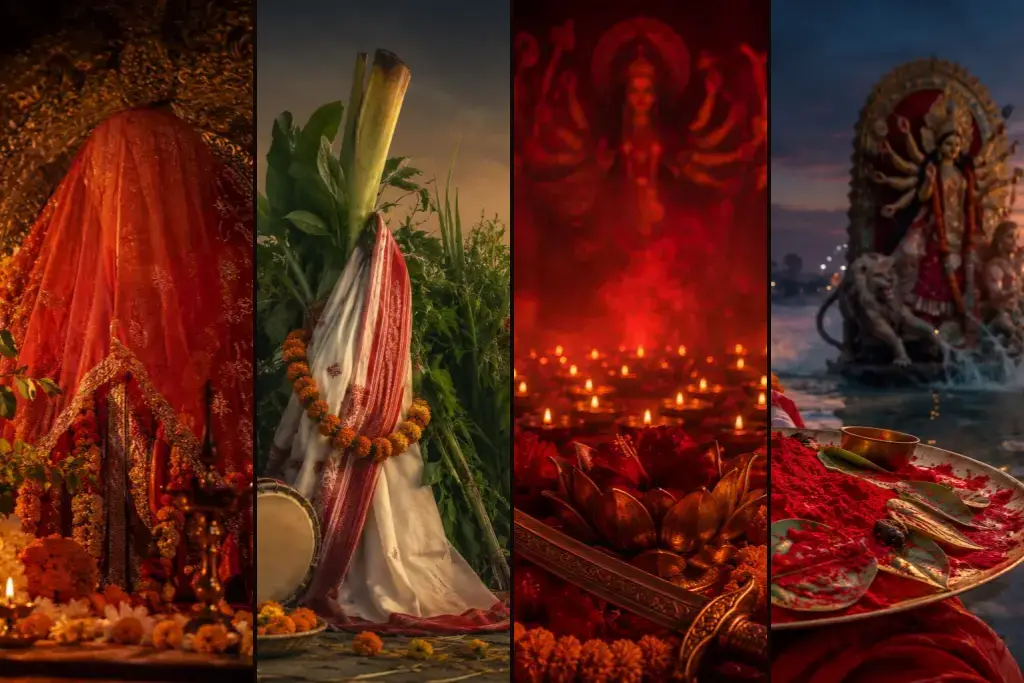
Each day has its own work. Maha Shashthi brings Bodhon, the awakening of the Goddess, and the unveiling of the image. Maha Saptami begins with the bathing of the Kola Bou (Navapatrika) and the main worship. Maha Ashtami is the busiest day, with the morning anjali and the Sandhi Puja at the meeting point of Ashtami and Navami. Maha Navami is the last full day of worship, and Vijaya Dashami closes the festival with Sindur Khela and the immersion.
The autumn puja is called Akal Bodhon, an out-of-season awakening, because the original worship of Durga was kept in spring. That spring puja still exists as Basanti Puja, in the month of Chaitra. When people search for Durga Puja they almost always mean this autumn festival.
Bengal fixes each day by the tithi that is current at sunrise. A tithi lasts a little less than a day, but it sometimes spans two sunrises; the puja day is then the first of the two, and the second date has no puja day of its own. So the five days do not always fit into five calendar days. In 2027 the Ashtami tithi is current at sunrise on both 7 and 8 October: Maha Ashtami is on 7 October, Maha Navami on 9 October, and the puja runs from 5 to 10 October. 2026 had the same thing with Shashthi, which ran from 16 to 21 October.
Rituals & observance
Most of the worship happens at community pandals, with the larger family pujas in homes. The core rites, day by day:
- Shashthi: Bodhon, Kalparambha (the vow to carry out the full puja) and Bilva Nimantran (inviting the Goddess into the bel tree). The covered face of the image is revealed and the pandals open.
- Saptami: the Kola Bou, a bundle of nine plants dressed in a red-bordered sari, is bathed at dawn and installed beside Ganesh. The Goddess is invoked into the image and the main daily worship begins.
- Ashtami: the morning pushpanjali (flower offering) draws the biggest crowds of the festival. Kumari Puja is held in some pandals, and the Sandhi Puja is performed with 108 lamps and 108 lotuses at the join of Ashtami and Navami.
- Navami: the Navami puja and homa (fire offering), the evening aarti, and the last full darshan and bhog before the farewell.
- Dashami: Darpan Bisarjan (the Goddess's reflection is shown in a mirror of water), Sindur Khela among married women, the procession and immersion, and Bijoya greetings with elders and neighbours.
- Through all five days: dhak drummers, evening pandal visits, new clothes, and bhog of khichuri, labra and payesh shared at the pandals.
Regional variations
How this date is determined
Observed on the Shashthi tithi of Ashwin (Shukla paksha), reckoned by sunrise (udaya tithi). Should the tithi fall across two days, tradition keeps the earlier day (purva-viddha).
Dates are computed to astronomical precision (NASA/JPL ephemeris), in line with traditional panchang.