Durga Ashtami
Goddess Durga
When it falls
The date shifts because it tracks the moon, not the Gregorian calendar.
Calculated for India (IST) using precise Panchang astronomy. Dates can shift by a day at locations far to the east or west.
Sharad Navratri & Dussehra
What Durga Ashtami marks
Durga Ashtami, commonly called Maha Ashtami, is the eighth day (ashtami tithi) of the bright fortnight of Sharad Navratri. Across much of India it is treated as one of the principal days of the nine — a day when devotees worship Goddess Durga in her warrior form, and many who fast through Navratri keep a stricter fast.
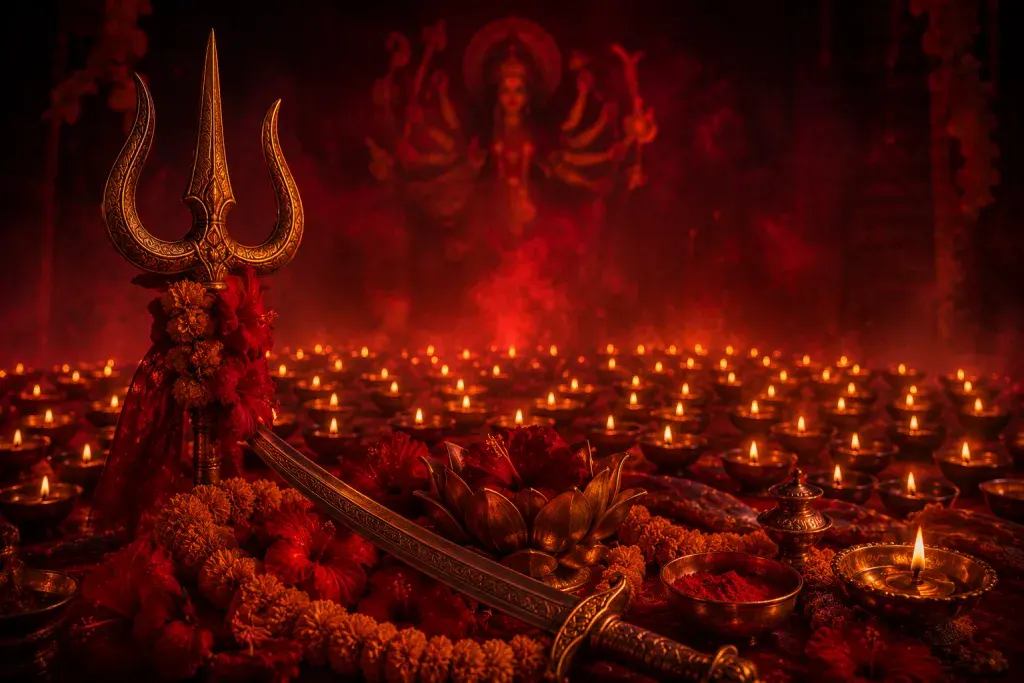
The day sits within the larger story of Navratri: the goddess waging a long battle against the buffalo-demon Mahishasura. On the eighth day she is honoured as the warrior closing in on victory, which is why weapons and tools — understood as the goddess's instruments — are cleaned and worshipped in the Astra Puja. In Bengal and the eastern tradition this is also a central day of Durga Puja, when the pandal worship is at its busiest.
The most distinctive moment of the day is the Sandhi Puja — worship performed in the short window where the eighth tithi ends and the ninth (navami) begins. This juncture is traditionally tied to the moment the goddess took her fiercest form (Chamunda) to slay the demon's generals. Many families also worship Mahagauri, the eighth of the nine Navadurga forms, on this day.
Rituals & observance
Observance ranges from a simple home fast to elaborate temple and pandal worship, but a few practices are common to Durga Ashtami across regions:
- Fast and morning worship. Those keeping the Navratri vrat observe the Ashtami fast and offer the day's puja to Durga, often with red flowers, kumkum, and a lamp; many break the fast only after the evening rites.
- Sandhi Puja. The defining ritual of the day, performed in the joining window of the eighth and ninth tithis. Where it is observed, the timing matters — check the local Sandhi window for 2027 rather than a fixed clock time.
- Astra Puja (worship of weapons and tools). Implements, tools, and in some homes books or instruments are cleaned and placed before the goddess, honouring her as the wielder of arms.
- Kanya Pujan / Kumari Puja. Young girls are invited, their feet washed, and they are fed and given small gifts as living forms of the goddess. In many North Indian homes this is done on Ashtami; in others it falls on Maha Navami.
- Bhog and offerings. A special meal (bhog) is prepared and offered, then shared. Regional dishes vary, but the food is first dedicated to the goddess before the family eats.
Regional variations
How this date is determined
Observed on the Ashtami tithi of Ashwin (Shukla paksha), reckoned by sunrise (udaya tithi). Should the tithi fall across two days, tradition keeps the earlier day (purva-viddha).
Dates are computed to astronomical precision (NASA/JPL ephemeris), in line with traditional panchang.