Maha Saptami
Goddess Durga
When it falls
The date shifts because it tracks the moon, not the Gregorian calendar.
Calculated for India (IST) using precise Panchang astronomy. Dates can shift by a day at locations far to the east or west.
Sharad Navratri & Dussehra
What Maha Saptami marks
Maha Saptami is the seventh day (saptami tithi) of the bright fortnight of Sharad Navratri. For most of India it is one of the building days of the nine-night festival, but in Bengal, Assam and Odisha it carries real weight of its own: it is the first of the three great days of Durga Puja — Saptami, Ashtami and Navami — the morning the goddess is formally received and the public worship truly begins.
The day sits inside the larger Navratri story of Durga's long battle with the buffalo-demon Mahishasura, but its own character is one of arrival rather than victory. Until now the image has been a sculpted form; on Saptami it is brought to life through the rite of pran pratishtha, the invocation of breath, so that the goddess is held to be present in the idol for the days of worship that follow.
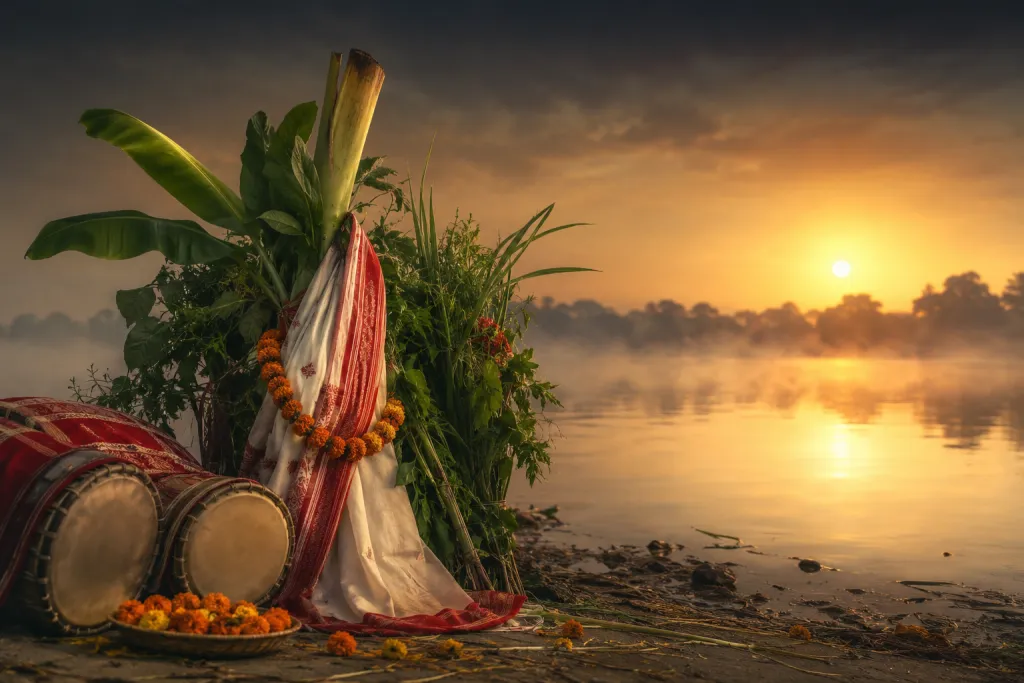
The most distinctive part of the day is the Navapatrika — a bundle of nine plants, each standing for a form of the goddess, bathed at dawn and dressed in a sari. It is popularly called Kola Bou (the banana-tree bride) after the banana plant at its centre, and it is placed beside Ganesha in the pandal. The custom is older than the sculpted clay images and ties the festival back to the worship of the goddess in the harvest and the living plant world.
Rituals & observance
For most households Saptami is a fasting and worship day within Navratri; in the eastern tradition it is the opening day of Durga Puja. Common observances include:
- Navapatrika (Kola Bou) snan. Before sunrise the bundle of nine plants is taken to a river or pond, bathed, dressed in a red-bordered sari and installed in the pandal — the rite that opens the three main days of Durga Puja.
- Pran pratishtha and morning puja. The goddess is invoked into the image and the day's worship begins, with the first of the collective floral offerings (anjali) made at homes and pandals.
- Fast and Durga worship. Those keeping the Navratri vrat continue their fast and offer the day's puja to Durga, often with red flowers and a lamp, recitation of the Durga Saptashati being common.
- Bhog and offering. A meal is cooked, dedicated first to the goddess and then shared. The food and dishes vary by region but the order — goddess first, family after — is kept.
- Darshan and gathering. In the east, families begin the rounds of pandal visiting that run through to Maha Navami, greeting relatives and taking darshan of the newly awakened image.
Regional variations
How this date is determined
Observed on the Saptami tithi of Ashwin (Shukla paksha), reckoned by sunrise (udaya tithi). Should the tithi fall across two days, tradition keeps the earlier day (purva-viddha).
Dates are computed to astronomical precision (NASA/JPL ephemeris), in line with traditional panchang.