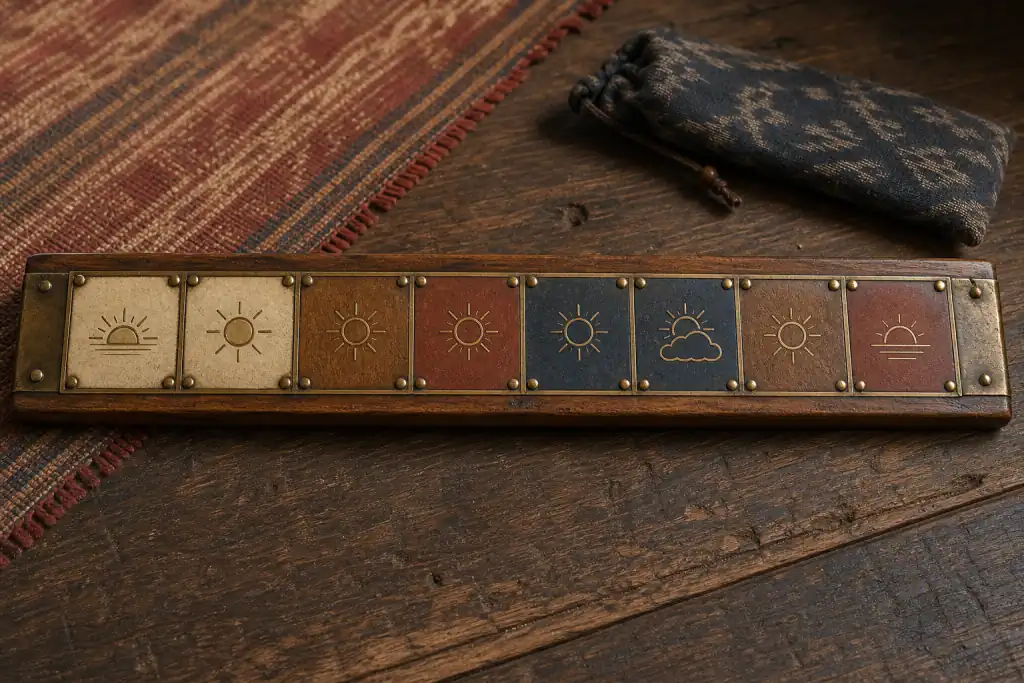
Choghadiya
Current Choghadiya
5:40 PM — 7:18 PM (1h 38m)
Good For: Medical Treatment
Avoid: Travel, Business, Marriage, New Beginnings
Day Choghadiya 6:11 AM — 7:18 PM
Night Choghadiya 7:18 PM — 6:12 AM
Understanding Choghadiya Types
Amrit (Most Auspicious)
The most auspicious period. Excellent for all important activities, especially starting new ventures, marriages, and religious ceremonies.
Shubh (Most Auspicious)
A very auspicious period meaning 'auspicious'. Great for marriages, religious ceremonies, and all positive activities.
Labh (Most Auspicious)
A highly auspicious period meaning 'profit'. Excellent for financial transactions, business deals, and starting new ventures.
Char (Good)
A movable period, good for travel, journeys, and moving activities. Moderately favorable for other tasks.
Udveg (Inauspicious)
Ruled by the Sun. Generally inauspicious, but can be suitable for government-related work and dealing with authorities.
Rog (Inauspicious)
Ruled by Mars. Inauspicious period associated with illness and conflict. Avoid starting new activities.
Kaal (Inauspicious)
Ruled by Saturn. Inauspicious for most activities. Only suitable for activities involving iron, machinery, or land.
What is Choghadiya?
Choghadiya (also spelled Chaughadia) is a popular Vedic time-division system used primarily in Gujarat and Western India for selecting auspicious moments during the day. The word derives from 'Cho' (four) and 'Ghadiya' (a traditional time unit of approximately 24 minutes), meaning each Choghadiya period spans roughly four Ghadiyas or about 96 minutes. The system divides the day (sunrise to sunset) into 8 equal periods and the night (sunset to next sunrise) into 8 equal periods, for a total of 16 Choghadiya periods per day.
Each Choghadiya period is named after one of seven types — Amrit, Shubh, Labh, Char, Udveg, Rog, and Kaal — and is classified as most auspicious, good, or inauspicious. The sequence of these types varies by weekday and follows a fixed pattern that repeats cyclically. Unlike the Hora system which assigns planetary rulers, Choghadiya classifies periods by their inherent quality, making it one of the simplest and most practical timing tools in Vedic astrology.
Choghadiya is especially popular for quick, everyday timing decisions. While a full Muhurat analysis considers dozens of factors, Choghadiya provides an immediate answer to the question: 'Is now a good time to start this activity?' Business owners, travelers, and families routinely consult Choghadiya before beginning journeys, signing contracts, or starting important tasks.
How Does Choghadiya Work?
The Choghadiya calculation begins with the exact sunrise and sunset times for the given date and location. The daytime duration (sunrise to sunset) is divided into 8 equal parts, giving 8 day-Choghadiya periods. Similarly, the nighttime duration (sunset to next sunrise) is divided into 8 equal parts for 8 night-Choghadiya periods. Because the length of day and night varies with season and latitude, each Choghadiya period's duration changes throughout the year — ranging from about 70 minutes in winter to over 100 minutes in summer.
The first Choghadiya of the day is determined by the weekday. Each day of the week starts with a specific Choghadiya type: Sunday starts with Udveg, Monday with Amrit, Tuesday with Rog, Wednesday with Labh, Thursday with Shubh, Friday with Char, and Saturday with Kaal. After the first period, the remaining seven follow the fixed sequence: Amrit, Kaal, Shubh, Rog, Labh, Udveg, Char — cycling through and skipping the starting type to avoid repetition.
The classification of each Choghadiya type is based on its ruling planet and traditional associations. Amrit (Moon), Shubh (Jupiter), and Labh (Mercury) are considered most auspicious and suitable for all important activities. Char (Venus) is moderately favorable, especially for travel. Udveg (Sun), Rog (Mars), and Kaal (Saturn) are classified as inauspicious — though each can be suitable for specific activities that align with their planetary nature.
The Seven Choghadiya Types
Ruled by the Moon. The most auspicious period, excellent for all important activities — marriages, religious ceremonies, starting new ventures, and any activity requiring divine blessings.
Ruled by Jupiter. Highly auspicious for education, spiritual activities, financial decisions, marriages, and all positive undertakings. Jupiter's wisdom brings success and good fortune.
Ruled by Mercury. The 'profit' period, excellent for business transactions, financial dealings, new ventures, contracts, and intellectual pursuits. Brings material gains and success.
Ruled by Venus. A movable, moderately favorable period. Best suited for travel, journeys, moving, and activities requiring movement or change. Acceptable for other tasks as well.
Ruled by the Sun. Generally inauspicious, but suitable for government-related work, dealing with authorities, and tasks requiring boldness. Avoid new ventures and ceremonies.
Ruled by Mars. Associated with illness and conflict. Avoid starting new activities, especially health-related or financial matters. Can be used for activities requiring physical strength or courage.
Ruled by Saturn. The most inauspicious Choghadiya type. Avoid all new beginnings and auspicious ceremonies. Only suitable for activities involving iron, machinery, land dealings, or agricultural work.
Frequently Asked Questions
Historical Origins of Choghadiya
The Choghadiya system has deep roots in the Gujarati and Rajasthani astrological traditions, dating back several centuries. The concept of dividing the day into auspicious and inauspicious segments appears in medieval Jyotish texts, but the specific Choghadiya framework became codified through the traditional Panchang almanacs of Western India. The system likely evolved from the broader Muhurat (electional astrology) tradition as a simplified, practical tool for everyday use by merchants, traders, and travelers — groups who needed quick timing guidance without consulting a professional astrologer.
The Gujarati mercantile tradition, with its emphasis on auspicious timing for business transactions, played a key role in popularizing Choghadiya. Traders would consult the Choghadiya before setting out on journeys, opening shops, or signing contracts. This practical, commerce-oriented use distinguishes Choghadiya from more scholarly timing systems like Hora. Even today, many Gujarati businesses begin their workday by checking the Choghadiya, and the system remains a staple feature of Gujarati Panchang publications and calendars.