Sharad Navratri
Goddess Durga
When it falls
The date shifts because it tracks the moon, not the Gregorian calendar.
Calculated for India (IST) using precise Panchang astronomy. Dates can shift by a day at locations far to the east or west.
Sharad Navratri & Dussehra
Why nine nights for the Goddess
Sharad Navratri falls in the bright fortnight of the lunar month of Ashwin, in early autumn (sharad), which gives the festival its name. Navratri simply means "nine nights" (nava ratri), and over those nights the Goddess is worshipped in nine forms known together as the Navadurga — from Shailaputri on the first night to Siddhidatri on the ninth. The tenth day, Vijaya Dashami, marks the close of the festival.
The story most often attached to these nights is the battle between Durga and the buffalo-demon Mahishasura. As the telling goes, Mahishasura could not be defeated by any single god, so the gods pooled their power into one warrior Goddess, who fought him for nine nights and killed him on the tenth. The festival is kept as the yearly remembrance of that victory, which is why the closing day carries the name Vijaya ("victory") Dashami. In the Rama tradition the same tenth day is remembered as the day Rama defeated Ravana, so the two stories share one date.
Of the four Navratris in the Hindu year, the autumn one is the most widely kept, which is why it is often called Maha Navratri ("great Navratri"). Its spring counterpart is Chaitra Navratri. The autumn festival also takes strongly regional shapes: in eastern India the last days become Durga Puja, while in western India the nights are filled with garba and dandiya dancing.
Rituals & observance
Observance combines daily worship of the Goddess with fasting and, in many homes and communities, music and dance each evening. Common practices include:
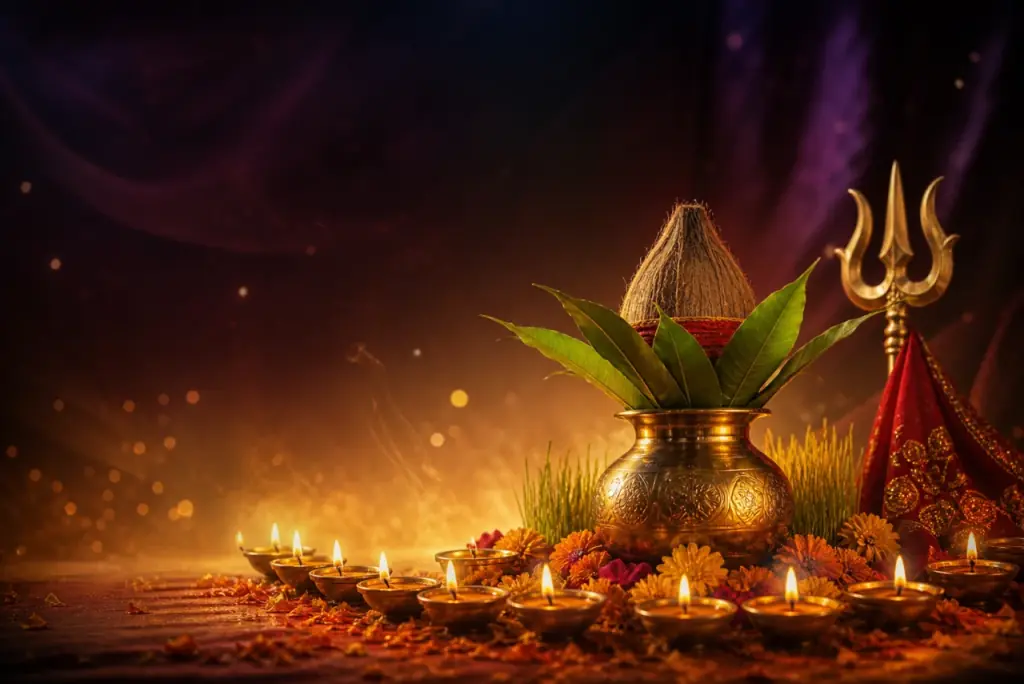
- Ghatasthapana (kalash sthapana) on the first morning — installing a consecrated pot of water, often with barley sown in soil around it, to invoke the Goddess for the nine days. This is the formal start of the festival and is done within a fixed auspicious window in the morning; check the day's panchang for the recommended time.
- Daily puja to the nine forms of Durga, one form per night, with lamp, flowers and the recitation of texts such as the Durga Saptashati (Devi Mahatmya).
- Fasting (vrat) for some or all nine days — many keep a single meal a day or eat only fruit, milk and non-grain "vrat" foods, avoiding grains, onion and garlic.
- Garba and dandiya-raas in the evenings, especially across Gujarat and the west, where the community dances in circles before an image or lamp of the Goddess.
- On the eighth and ninth days — Durga Ashtami and Maha Navami — special offerings and, in many homes, Kanya Pujan, where young girls are honoured and fed as embodiments of the Goddess.
- Closing on the tenth day, Dussehra (Vijaya Dashami), often marked by immersing the Durga image, exchanging greetings and beginning new ventures.
Regional variations
How this date is determined
Observed on the Pratipada tithi of Ashwin (Shukla paksha), reckoned by sunrise (udaya tithi).
Dates are computed to astronomical precision (NASA/JPL ephemeris), in line with traditional panchang.