Maha Navami
Goddess Durga
When it falls
The date shifts because it tracks the moon, not the Gregorian calendar.
Calculated for India (IST) using precise Panchang astronomy. Dates can shift by a day at locations far to the east or west.
Sharad Navratri & Dussehra
Significance & story
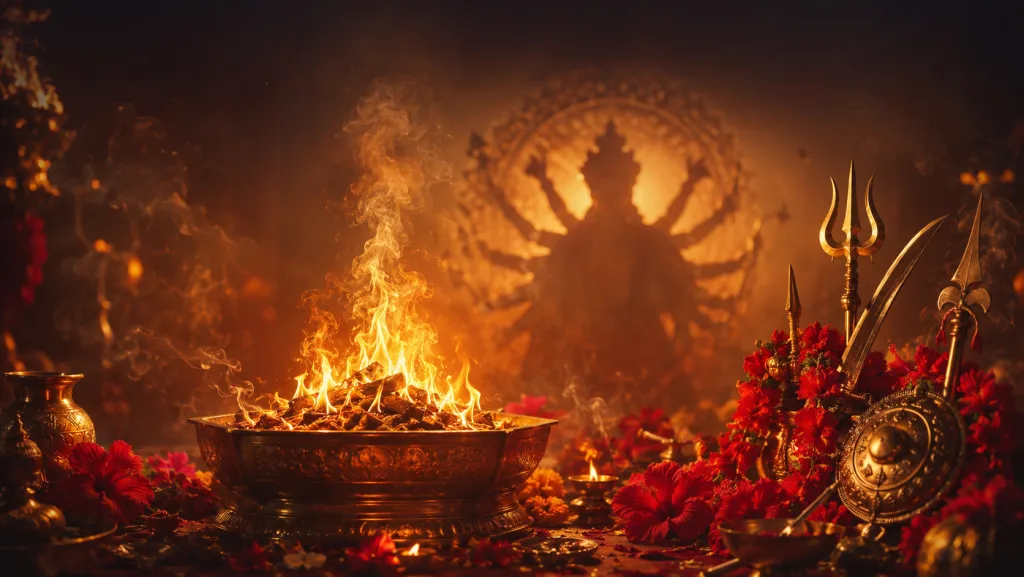
Maha Navami is the ninth day of Sharad Navratri and the last of its three days given to Durga as a warrior. The nine nights tell the story of a long battle: the buffalo-demon Mahishasura had won a boon that no man or god could kill him, and the goddess — formed from the combined power of all the devas — fought him across the days the nine nights now mark. On Navami the fighting reaches its end; the next day, Dussehra, marks the victory itself.
Across the nine nights Durga is honoured in nine forms, one per day, and Navami belongs to Siddhidatri — the giver of attainment, the form in which the goddess's work is complete. This is why Navami is usually the largest puja day of the nine for most households and temples: the fast that began on the first day is brought to a close, the most elaborate offerings are made, and in many homes young girls are invited and fed as living embodiments of the goddess (Kanya Pujan).
In Bengal, Assam and Odisha the same day is the third great day of Durga Puja, following Maha Saptami and Maha Ashtami. The pandals are at their busiest, the final anjali (flower offering) is made, and families gather before the immersion that comes the following day. It is the high point of the celebration, and also the last full day before the goddess departs.
Rituals & observance
How Maha Navami is kept:
- The main rite is the Navami puja and havan (fire offering), which closes the nine-day worship and, for those who fasted, releases the fast.
- Kanya Pujan (also called Kanjak): young girls are invited home, their feet washed, and they are served a meal of puri, halwa and chana and sent off with small gifts — worshipped as forms of the goddess.
- Durga is worshipped specifically as Siddhidatri, the ninth Navratri form; her mantra and the relevant chapter of the Durga Saptashati are recited.
- In many regions this is Ayudha Puja — tools, machines, vehicles and books are cleaned and worshipped, honouring the instruments of one's work before taking them up again.
- In the Bengal–Odisha Durga Puja tradition, the final anjali is offered at the pandal and families take darshan before the next day's immersion.
Regional variations
How this date is determined
Observed on the Navami tithi of Ashwin (Shukla paksha), reckoned by the afternoon (aparahna).
Dates are computed to astronomical precision (NASA/JPL ephemeris), in line with traditional panchang.