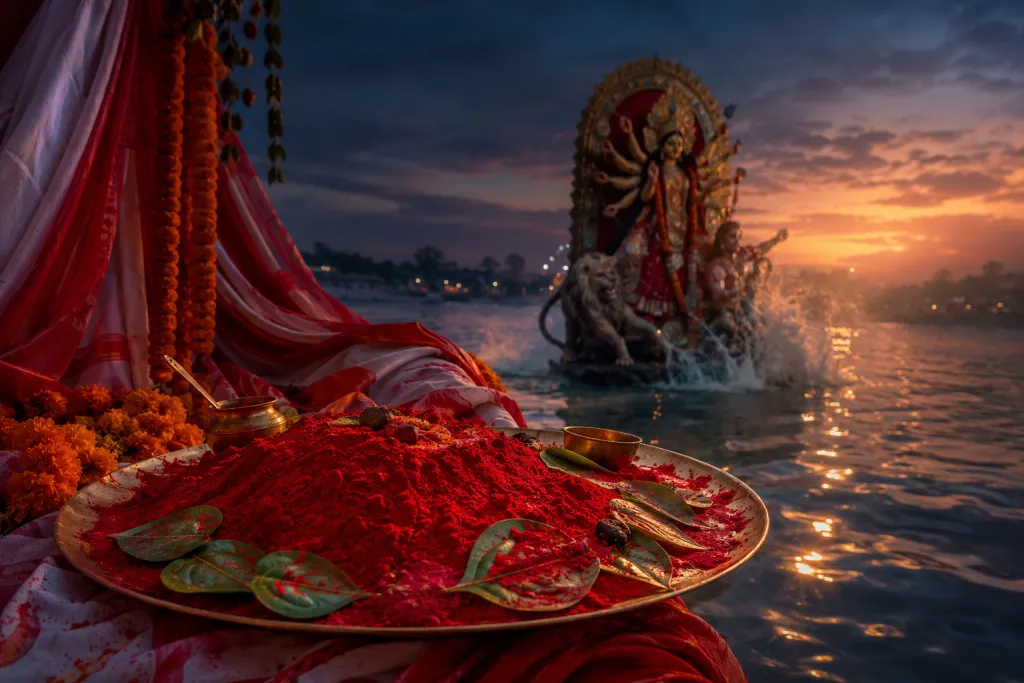
Vijaya Dashami
Goddess Durga
When it falls
The date shifts because it tracks the moon, not the Gregorian calendar.
Calculated for India (IST) using precise Panchang astronomy. Dates can shift by a day at locations far to the east or west.
Sharad Navratri & Dussehra
Why Vijaya Dashami matters
Vijaya Dashami means the "tenth day of victory." It remembers Goddess Durga's defeat of the buffalo-demon Mahishasura after a battle that, in the telling, lasted nine nights — the same nine nights worshippers keep through Navratri and the days of Durga Puja. The tenth day is when the victory is complete, which is why it carries the name Vijaya.
In Bengal the day has a second, more tender meaning. Through Durga Puja the Goddess is treated as a married daughter who has come home to her parents for a few days. Dashami is the day she leaves to return to her husband Shiva in the Himalayas. That is why the close of the Puja feels both triumphant and sad: the city celebrates her victory and, in the same breath, sees her off. The Bengali greeting Shubho Bijoya and the visits, embraces, and sweets that follow are part of that farewell.
There is also a calendar point worth knowing. Vijaya Dashami and the pan-India Dussehra share the same lunar day — the tenth of bright Ashwin — but Bengal keeps it on the sunrise tithi, so the two can occasionally land on different dates. Across much of the rest of India the same day is observed as Dussehra, recalling Rama's victory over Ravana rather than the immersion of Durga.
Rituals & observance
Vijaya Dashami is the last day of the Durga Puja sequence that opens with Maha Shashthi and builds through Maha Saptami, Maha Ashtami, and Maha Navami. On Dashami the worship is brought to a close and the Goddess is sent home. The main observances are:
- Darpan Bisarjan — a closing ritual in which the Goddess's reflection is shown in a mirror or vessel of water, symbolically taking leave of her before the idol itself is moved for immersion.
- Sindur Khela — married women offer vermilion (sindur) to Durga and then apply it to one another's faces and hair-partings, exchanging blessings for the long life and wellbeing of their families.
- Bisarjan (immersion) — the clay idols are carried in procession, usually with drumming, and immersed in a river, pond, or the sea, returning the Goddess to the water and formally ending the Puja.
- Bijoya greetings — after the immersion, families visit elders and neighbours to seek and give blessings with the greeting Shubho Bijoya, sharing sweets and savouries such as narkel naru and nimki.
- Aparajita and Shami worship — in many homes the Aparajita creeper or Shami tree is honoured on this day, a custom that ties the Bengali Dashami to the wider Dussehra tradition of invoking protection and success for the year ahead.
Regional variations
How this date is determined
Observed on the Dashami tithi of Ashwin (Shukla paksha), reckoned by sunrise (udaya tithi). Should the tithi fall across two days, tradition keeps the earlier day (purva-viddha).
Dates are computed to astronomical precision (NASA/JPL ephemeris), in line with traditional panchang.