Maha Navami (Durga Puja)
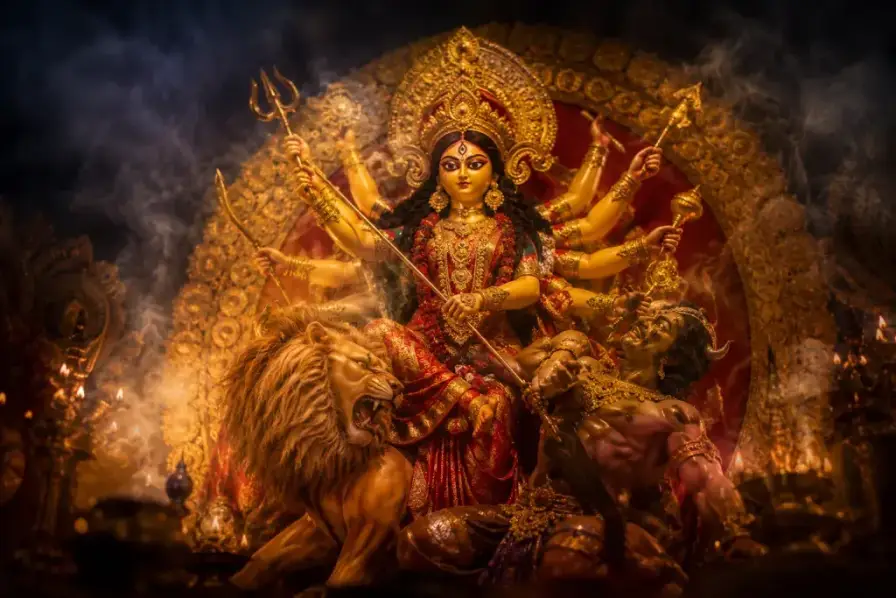
Goddess Durga
When it falls
The date shifts because it tracks the moon, not the Gregorian calendar.
Calculated for India (IST) using precise Panchang astronomy. Dates can shift by a day at locations far to the east or west.
Sharad Navratri & Dussehra
Significance & story
Maha Navami is the same Ashwin Navami marked across India, but in the eastern tradition it is read through Durga Puja. It is the third of the four great days — following Maha Saptami and Maha Ashtami — and it is when worship of the goddess is at its fullest. The story behind it is the war the nine nights tell: Durga, formed from the combined strength of the gods, fought the buffalo-demon Mahishasura through these days, and Navami is the day the battle is brought to its close before the victory marked on the tenth.
The most distinctive rite of the eastern tradition sits not on Navami itself but on the join between Ashtami and Navami — the Sandhi Puja, performed in the last twenty-four minutes of Ashtami and the first twenty-four minutes of Navami. In the telling, this is the moment Durga took her fiercest form (Chamunda) to kill the demons Chanda and Munda, and the puja honours that turning point with a great offering of lamps and flowers. It is one of the most charged moments of the whole festival, fixed by the tithi rather than by the clock, which is why its timing shifts each year.
Navami is also, plainly, the last full day the goddess is at home. Pandals are at their busiest, the great anjali (flower offering) is made, and many families take their final unhurried darshan before the next day's immersion. The mood carries both the height of the celebration and the quiet knowledge that the farewell — Bijoya, on Dussehra — comes the following morning.
Rituals & observance
How Maha Navami is kept in the Durga Puja tradition:
- The Sandhi Puja at the join of Ashtami and Navami is the day's defining rite — a fixed forty-eight-minute window of intense worship, often marked by lighting 108 lamps and an offering of 108 lotuses.
- The main Navami puja and homa (fire offering) is performed at the pandal, the most elaborate worship of the four days.
- The great anjali — the flower offering made collectively before the image — is given, often the largest gathering of the festival.
- Kumari Puja, where a young girl is worshipped as a living form of the goddess, is held in some pandals and homes (in many places it falls on Ashtami; practice varies).
- Families take their last full darshan and bhog (the consecrated meal) at the pandal before the immersion that comes the next day.
- For those keeping the Navratri fast in the wider tradition, it is usually concluded with the Navami puja; in Bengal the day is given more to community worship than to household fasting.
Regional variations
How this date is determined
Observed on the Navami tithi of Ashwin (Shukla paksha), reckoned by sunrise (udaya tithi). Should the tithi fall across two days, tradition keeps the earlier day (purva-viddha).
Dates are computed to astronomical precision (NASA/JPL ephemeris), in line with traditional panchang.