Nag Pancham
Naga (Serpent deities)
When it falls
The date shifts because it tracks the moon, not the Gregorian calendar.
Calculated for India (IST) using precise Panchang astronomy. Dates can shift by a day at locations far to the east or west.
What Nag Pancham marks
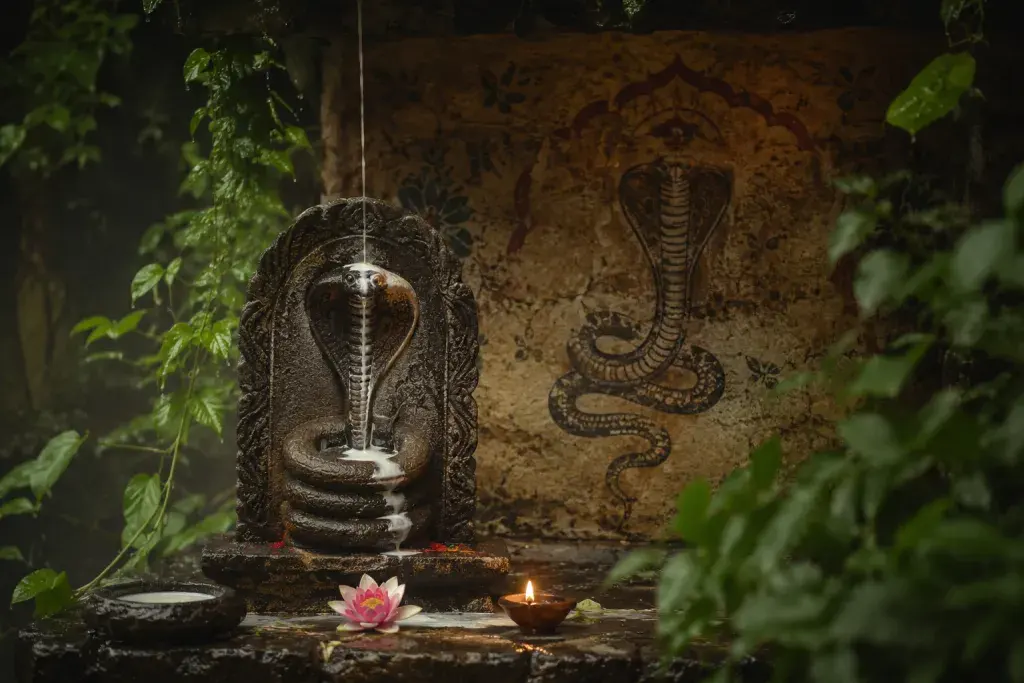
Nag Pancham is a day set aside to honour the serpent deities, known collectively as the Naga. In Hindu tradition the serpent is not treated as a pest to be feared but as a being woven into the divine order — Lord Shiva wears the serpent Vasuki, Lord Vishnu rests on the cosmic serpent Shesha, and snakes are seen as guardians of the earth, water, and hidden treasure. Worshipping them on this day is an act of respect and a request for protection, especially from snakebite during the monsoon, when snakes leave flooded burrows and come closer to homes and fields.
The Gujarat observance has a distinctive feature: it falls in the dark fortnight (Krishna Paksha) of the month, not the bright fortnight. This places it within the cluster of Shravan Vad festivals — sitting between Bol Choth and Randhan Chhath — rather than alongside the bright-fortnight Nag Panchami kept across much of North India. Both are serpent-worship days with the same spirit; the difference is which half of the lunar month each region settles on.
Because the date is tied to a specific tithi (the fifth lunar day, Panchami), it shifts each year against the Gregorian calendar. This year it is observed on 22 August 2027, which is in 306 days away.
Rituals & observance
The day is kept simply and at home, with the cobra at the centre of the offerings. Common observances include:
- Offering milk, and sometimes water and flowers, to a snake idol, a snake image, or a snake pit (bambi) where one is nearby.
- Drawing or installing an image of a cobra — often on a wall or doorway with kumkum and turmeric — and worshipping it with incense, lamps, and a short prayer.
- Offering simple food such as milk, sweets made of milk, or grains, and avoiding anything that would cut or dig the earth (some families refrain from frying, ploughing, or digging out of respect for creatures that live in the ground).
- Praying for the safety of the household from snakebite, a real concern in rural and monsoon-season Gujarat, and for the general welfare of the family.
- Keeping the observance within the wider Shravan Vad rhythm — many families fold it into the same week as the cooking and Shitala observances that follow it, such as Randhan Chhath and Shitala Satam.
How this date is determined
Observed on the Panchami tithi of Bhadrapada (Krishna paksha), reckoned by sunrise (udaya tithi).
Dates are computed to astronomical precision (NASA/JPL ephemeris), in line with traditional panchang.