Nag Panchami (Bengali)
Manasa, Naga (Serpent deities)
When it falls
The date shifts because it tracks the moon, not the Gregorian calendar.
Calculated for India (IST) using precise Panchang astronomy. Dates can shift by a day at locations far to the east or west.
Why Bengal Keeps Nag Panchami Differently
Across most of India, Nag Panchami falls on the fifth day of the bright fortnight (Shukla Paksha) of Shravan. Bengal keeps it instead in the dark fortnight (Krishna Paksha) of the same monsoon season, so the Bengali date lands about two weeks apart from the pan-India Nag Panchami. The object of worship is the same — the serpent deities (Nagas) — but the calendar and the surrounding tradition are local to the east.
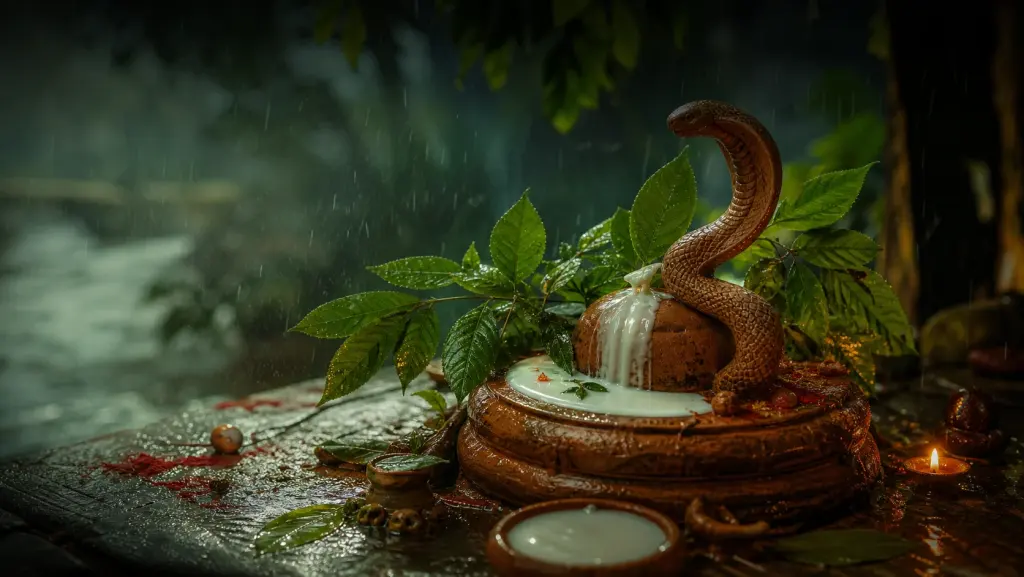
What sets the Bengali observance apart is its tie to the goddess Manasa, the protector against snakebite and the giver of fertility. In Bengal, serpent reverence is hard to separate from her worship: the snakes are honoured, but it is Manasa who is asked to hold back their venom and keep the household safe. This reflects the season's real danger, when monsoon flooding drives snakes out of their burrows and into fields and homes, and snakebite is a genuine threat to farming families.
The day therefore carries both a practical and a devotional weight. Honouring the Nagas is an old way for an agricultural community to ask for safety during the months when people and serpents come closest, while the figure of Manasa gives that appeal a clear protector to turn to. The spirit throughout is respect rather than fear — the serpents are given their due, not driven off.
Rituals & observance
Observance is centred on offerings to the serpents and to the goddess Manasa, usually in the forenoon. Practice varies by family and district, but the common elements are these:
- Clean the worship space and set up an image of a serpent — drawn on a wall or floor, moulded in clay, or worshipped at a snake idol, anthill, or temple.
- Offer milk, water, turmeric, vermilion (sindur), flowers, and unbroken rice to the Naga, often alongside an image or branch representing the goddess Manasa.
- Light a lamp and incense, recite the names of the principal Nagas, and ask Manasa for the family's protection against snakebite.
- Many households avoid digging the earth, ploughing, or cutting on this day, taking care not to disturb or injure snakes in their burrows.
- Where the local tradition keeps it, women of the household lead the worship and pray for the safety and wellbeing of their family through the monsoon.
Regional variations
How this date is determined
Observed on the Panchami tithi of Bhadrapada (Krishna paksha), reckoned by the forenoon (purvahna). Should the tithi fall across two days, tradition keeps the day with the greater overlap (adhika-vyapti).
Dates are computed to astronomical precision (NASA/JPL ephemeris), in line with traditional panchang.