Shitala Satam
Goddess Shitala
When it falls
The date shifts because it tracks the moon, not the Gregorian calendar.
Calculated for India (IST) using precise Panchang astronomy. Dates can shift by a day at locations far to the east or west.
Why Shitala Satam is observed
Shitala Satam falls on the seventh day (saptami) of the dark fortnight of the Gujarati month Shravan (Shravana Krishna Saptami). It is part of the cluster of monsoon observances in western India known as Shravan Vad, which also includes Bol Choth, Nag Pancham and Randhan Chhath. The festival centres on Shitala (literally "the cool one"), a folk goddess long associated with relief from fevers, smallpox and other heat- and season-related illnesses.
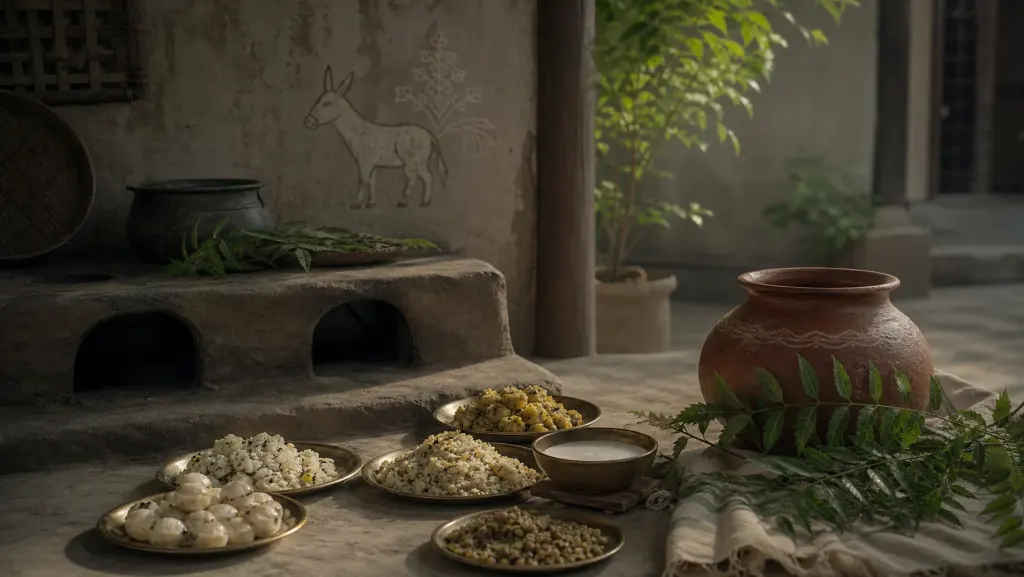
The defining custom is that no fresh cooking is done. The day before, on Randhan Chhath, the year's last hot meal is prepared; on Shitala Satam itself the stove is left cold and the household eats that previously cooked, room-temperature food. The unlit hearth is offered as a small rest to the fire and a gesture of devotion to a goddess whose very name means coolness — a fitting note in the heat and disease season of the late monsoon.
Shitala Satam is distinct from Sheetala Ashtami, also called Basoda, which honours the same goddess but falls in Chaitra (around spring) and is kept more widely across North India. Both share the cold-food principle, but they sit in different months and are observed by different regional communities.
Rituals & observance
Shitala Satam is a quiet, home-centred observance built around one rule: the kitchen fire stays unlit for the day. The practical preparation happens the evening before.
- Cook ahead on Randhan Chhath: the day before, families prepare the dishes that will be eaten cold on Shitala Satam, then clean the stove and let it rest.
- Keep the hearth unlit through Shitala Satam — no fresh cooking or reheating; the previously prepared food is eaten at room temperature.
- Bathe and offer worship to Goddess Shitala in the morning, often before a home image or at a local Shitala shrine.
- Make simple offerings such as the cooked (cold) food, water and seasonal items, with prayers for the family's health and protection from illness.
- Where it is the custom, women keep a light fast or eat only the cold prepared food for the day.
- Resume normal cooking the following day once the observance is complete.
Regional variations
How this date is determined
Observed on the Saptami tithi of Bhadrapada (Krishna paksha), reckoned by dusk (pradosh kala). Should the tithi fall across two days, tradition keeps the day with the greater overlap (adhika-vyapti).
Dates are computed to astronomical precision (NASA/JPL ephemeris), in line with traditional panchang.