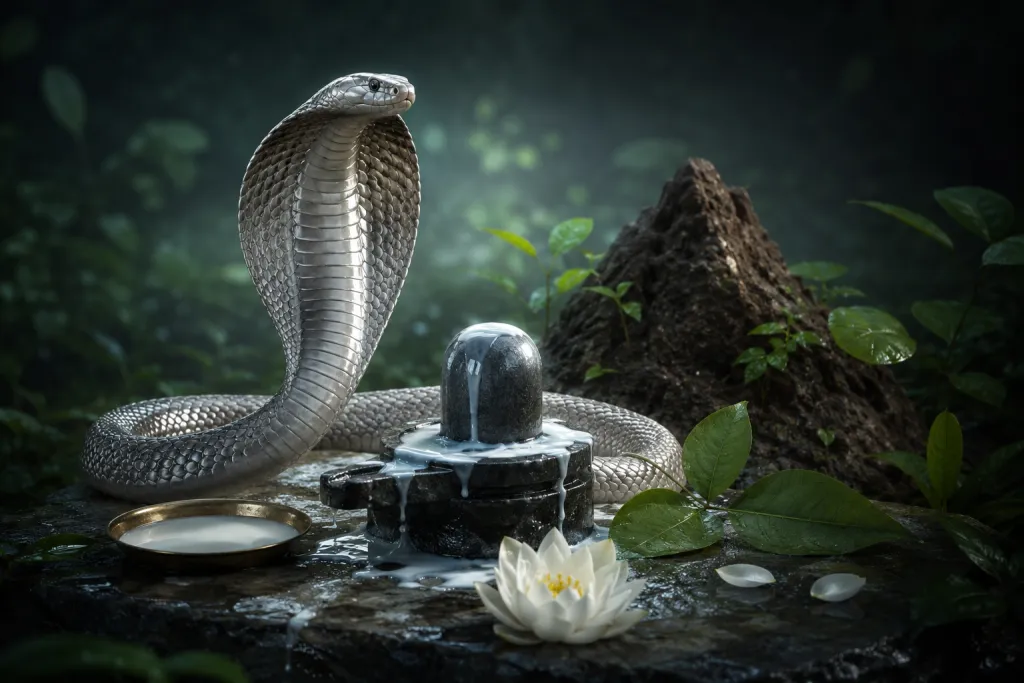
Nag Panchami
Naga (Serpent deities)
When it falls
The date shifts because it tracks the moon, not the Gregorian calendar.
Calculated for India (IST) using precise Panchang astronomy. Dates can shift by a day at locations far to the east or west.
Why Nag Panchami Is Observed
Nag Panchami honours the serpent deities (Nagas), who have a long-standing place in Hindu thought as guardians of water, of the earth, and of the household. The most familiar images are Shesha, the great serpent on whom Vishnu rests, and the snakes coiled around Shiva — so the day is less about the animal itself than about the divine power it stands for.
The timing has a practical root as well. Nag Panchami falls in Shravan, the middle of the monsoon, when flooded burrows drive snakes into fields, paths, and homes, and snakebite is a real danger to farming families. Worshipping the Nagas on this day is, in part, a long-held way for an agricultural community to ask for safety during the season when people and serpents come closest.
Several stories are attached to the festival, including Krishna subduing the serpent Kaliya in the Yamuna, and accounts in the Mahabharata of the serpent sacrifice and its halting. Across these, the common thread is respect rather than fear: the Nagas are appeased and given their due rather than destroyed, and harming a snake on this day is traditionally avoided.
Rituals & observance
Observance is simple and centred on offerings to the serpent deities, usually in the morning. Practices vary by region and family, but the common elements are these:
- Bathe and clean the worship space, then make an image of a serpent — drawn on a wall or floor, moulded in clay, or worshipped at a snake idol, temple, or anthill.
- Offer milk, water, turmeric, vermilion (kumkum), flowers, and unbroken rice to the Naga, along with sweets such as kheer.
- Light a lamp and incense, recite the names of the principal Nagas (Ananta, Vasuki, Takshaka, and others), and ask for the protection of the family.
- Many families avoid digging the earth, ploughing, and cutting on this day, taking care not to disturb or injure snakes in their burrows.
- Married women in some regions pray for the wellbeing of their brothers and household, and visit Naga shrines or temples to complete the worship.
Regional variations
How this date is determined
Observed on the Panchami tithi of Shravana (Shukla paksha), reckoned by sunrise (udaya tithi).
Dates are computed to astronomical precision (NASA/JPL ephemeris), in line with traditional panchang.