Bol Choth
Bahula (the cow)
When it falls
The date shifts because it tracks the moon, not the Gregorian calendar.
Calculated for India (IST) using precise Panchang astronomy. Dates can shift by a day at locations far to the east or west.
The story and meaning of Bol Choth
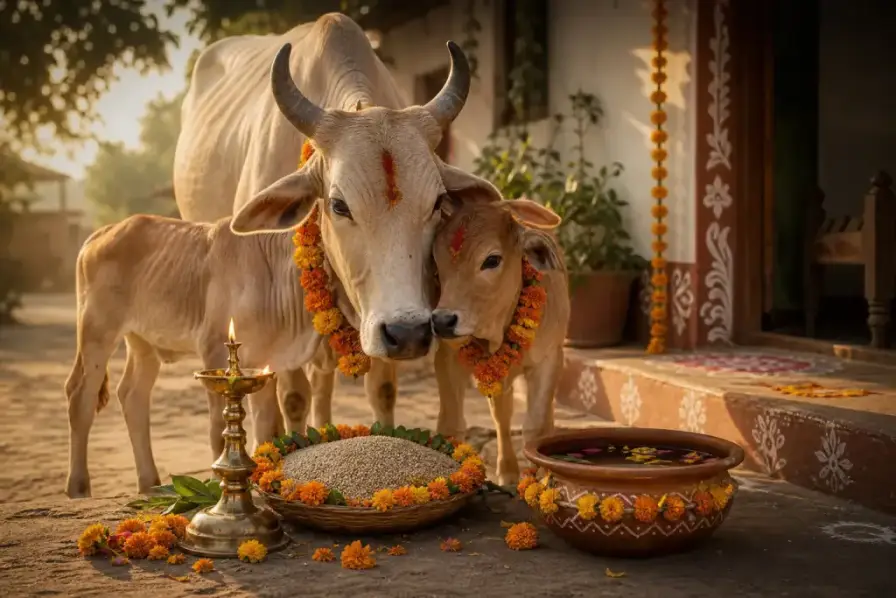
Bol Choth, more formally Bahula Chauth, is kept on the fourth day (Chaturthi) of the dark fortnight of Bhadrapada. It is one of the cluster of Shravan-Vad observances that Gujarati households keep in the run-up to Janmashtami, and its focus is the cow and her calf, worshipped here as Bahula.
The day is tied to the well-known story of the cow Bahula, who asked a hungry lion to let her feed her calf and return. She kept her word and came back to be eaten; moved by her honesty, the lion spared her. The cow's truthfulness and devotion to her calf are why she is honoured on this day, and why the festival is read as a celebration of a mother's care for her young.
For most families the practical heart of Bol Choth is the vrat that women keep for the health and long life of their children, especially sons in the older tradition. It is a domestic, regional observance rather than a temple-centred one, and it sits naturally before Janmashtami, when Krishna's own bond with cows and cowherds is remembered.
Rituals & observance
Bol Choth is kept mainly at home and in the cowshed, with the main worship done in the afternoon. The customs are simple and centre on respect for the cow and her calf.
- Women observing the vrat take a bath and worship a cow and her calf, often applying a tilak, offering water and fodder, and circling them in reverence.
- The day's food avoids grain cut or ground with a blade, so wheat is set aside in favour of preparations from moong, bajra, or other whole grains.
- Milk and milk products taken from the cow are also avoided for the day, as a mark of leaving the calf's share untouched.
- Where keeping a live cow is not possible, families may worship an image of a cow and calf, or visit a nearby cowshed or gaushala.
- Older women often narrate the katha (story) of Bahula to the household before the meal, keeping the meaning of the vrat alive for the next generation.
Regional variations
How this date is determined
Observed on the Chaturthi tithi of Bhadrapada (Krishna paksha), reckoned by the afternoon (aparahna). Should the tithi fall across two days, tradition keeps the day with the greater overlap (adhika-vyapti).
Dates are computed to astronomical precision (NASA/JPL ephemeris), in line with traditional panchang.