Diwali
Goddess Lakshmi
When it falls
The date shifts because it tracks the moon, not the Gregorian calendar.
Calculated for India (IST) using precise Panchang astronomy. Dates can shift by a day at locations far to the east or west.
The five days of Diwali
Significance & story
Diwali marks the return of light after the year's darkest fortnight. The familiar story is Rama's homecoming to Ayodhya after fourteen years of exile, the city lit row on row to guide him back. The deeper logic is simpler still: on the one night the moon gives no light at all, every household makes its own.
Lakshmi, the goddess of fortune, is said to enter homes that are cleaned, opened and lit — which is why the days before are spent scrubbing thresholds and the night itself spent with every lamp kept burning. It is a festival of invitation, not just celebration: you prepare the house so good fortune has somewhere to arrive.
Rituals & observance
How Diwali is kept:
- The central rite is the evening Lakshmi-Ganesha puja, done at pradosh rather than late at night.
- Homes are cleaned and whitewashed beforehand; the threshold is marked with rangoli and a trail of footprints drawn inward to invite the goddess.
- Traders close the old account books and open new ones (Chopda Pujan).
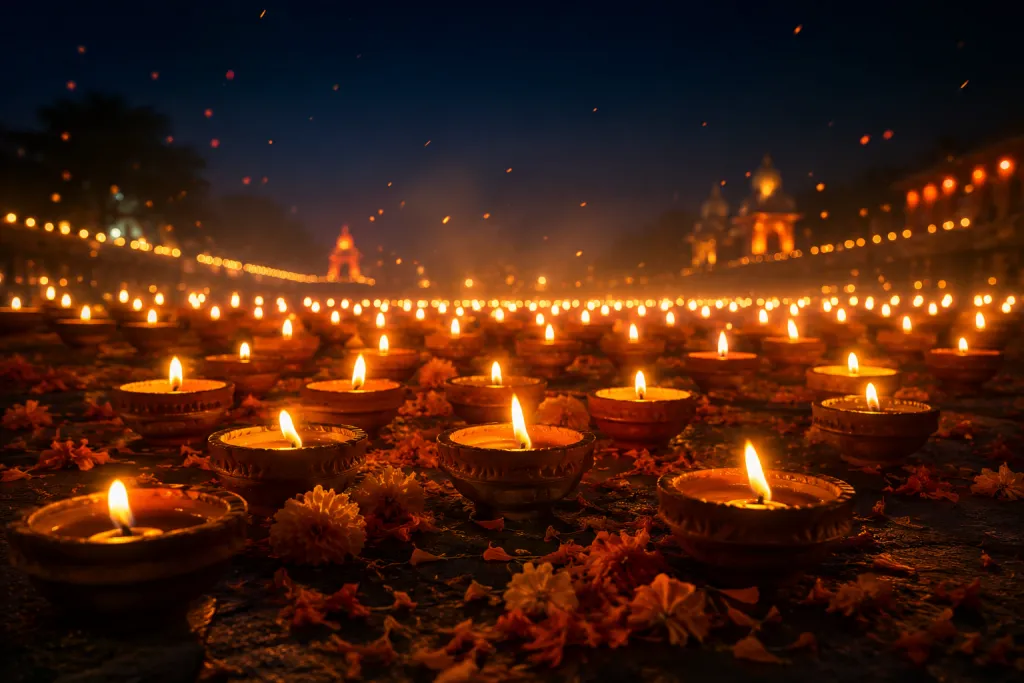
- Diyas are lit at every door, window and water-source and kept burning through the night.
Chopda Pujan — the traders' new year
For merchant communities, Diwali night is when the old account books (chopda) are closed and freshly worshipped ledgers are opened — a ritual start to the financial year, performed at the same pradosh window as the Lakshmi puja.
Regional variations
How this date is determined
Observed on the new-moon day (Amavasya) of Kartik (Krishna paksha), reckoned by dusk (pradosh kala). Should the tithi fall across two days, tradition keeps the day with the greater overlap (adhika-vyapti).
Dates are computed to astronomical precision (NASA/JPL ephemeris), in line with traditional panchang.