Govardhan Puja
Lord Krishna
When it falls
The date shifts because it tracks the moon, not the Gregorian calendar.
Calculated for India (IST) using precise Panchang astronomy. Dates can shift by a day at locations far to the east or west.
The five days of Diwali
Significance & story
Govardhan Puja remembers the day the young Krishna lifted Govardhan hill on one finger to shelter the cowherds of Braj from a week of punishing rain. The villagers had been preparing an elaborate offering to Indra, the rain god, when Krishna argued that their real sustenance came from the hill, the forest, and their cattle — not from a distant deity to be appeased out of fear. When Indra answered with a storm, Krishna raised the hill as an umbrella and held it until the rain stopped.
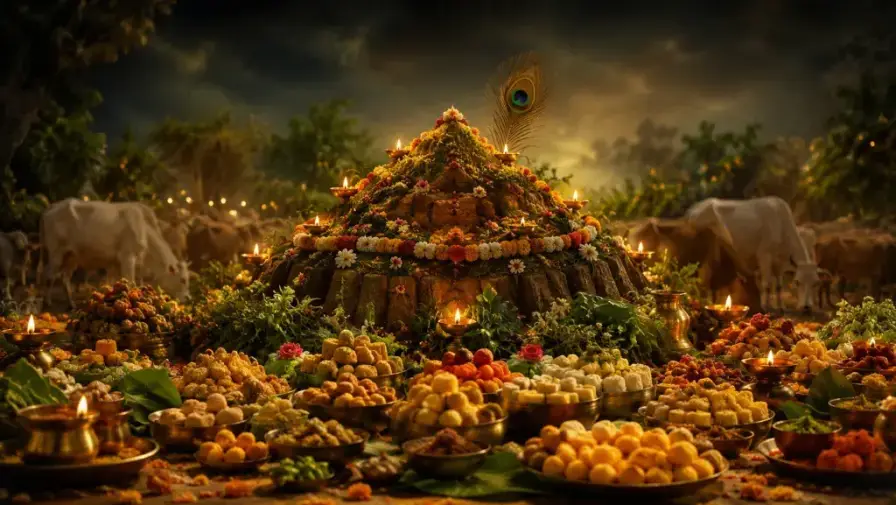
Read plainly, the festival is a thanksgiving for the land and the herd: it honours the things that actually feed people — soil, pasture, cattle, and rain in its right measure. That is why the central offering is food itself, heaped into the shape of a hill, and why the cow is honoured on the same day. The gratitude is turned toward what is near and dependable rather than what is grand and far away.
It falls on the first day of the bright half of Kartik, the morning after the Diwali new moon, and forms part of the larger Diwali cluster of days that close out the Hindu festival year.
Rituals & observance
How Govardhan Puja is kept:
- The defining rite is the annakut — dozens of cooked dishes arranged into a mound before the deity, offered to Krishna and later shared as prasad. Temples in Braj and across north India build especially large displays.
- A small replica of Govardhan hill is made from cow dung, decorated with flowers, and worshipped in the courtyard; some families shape it as a reclining figure of Krishna.
- Cows and bulls are bathed, garlanded, and fed first, in keeping with the day's link to cattle and the herd.
- Families walk a circuit (parikrama) around the dung hill or, in Braj, around Govardhan hill itself.
- In many homes the day doubles as a thanksgiving for the kitchen and the harvest, so the cooking is deliberately abundant and varied.
Regional variations
How this date is determined
Observed on the Pratipada tithi of Kartik (Shukla paksha), reckoned by the afternoon (aparahna). Should the tithi fall across two days, tradition keeps the day with the greater overlap (adhika-vyapti).
Dates are computed to astronomical precision (NASA/JPL ephemeris), in line with traditional panchang.