Kali Puja
Goddess Kali
When it falls
The date shifts because it tracks the moon, not the Gregorian calendar.
Calculated for India (IST) using precise Panchang astronomy. Dates can shift by a day at locations far to the east or west.
Significance & story
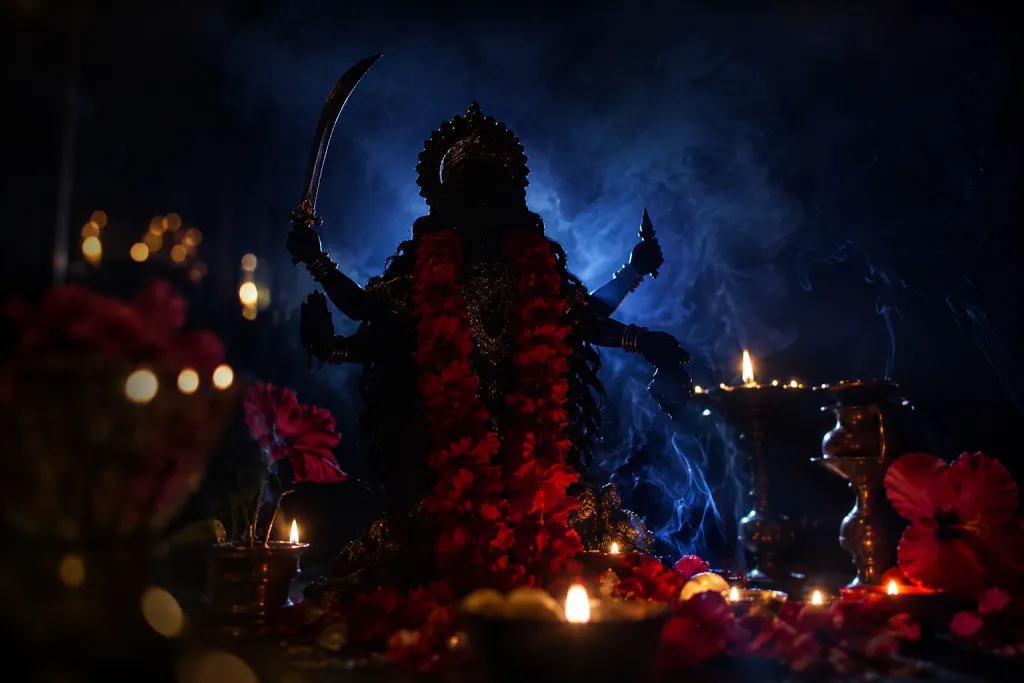
Kali Puja honours Kali, the fierce form of the Mother Goddess — the same Shakti worshipped as Durga and Parvati, here in the aspect that confronts and destroys evil. The familiar image is stark: dark-skinned, garlanded with severed heads, tongue out, standing over the prone figure of Shiva. The story behind it is that Kali, having slain the demons, danced on in unstoppable fury until Shiva lay down in her path to stop her; the moment her foot touched him, she paused. It is an image about force that has to be met and steadied, not one meant only to frighten.
She is approached as a protective mother rather than a hostile power. Devotees turn to Kali to clear obstacles, fear and harmful influence, which is why the worship carries a serious, intense tone rather than the festive brightness of the Lakshmi puja kept on the same night elsewhere. In Bengal she is often called Shyama, and the night belongs to her.
Both festivals share the Kartik Amavasya, the year's darkest night, but read it differently. Where Diwali lights lamps to invite fortune in, Kali Puja faces the dark directly and calls on the goddess who governs it. The astronomy is identical — one new moon — but the devotional choice is opposite, and that contrast is the heart of why two such different festivals fall on the same date.
Rituals & observance
How Kali Puja is kept:
- The main worship is done at midnight (nishita), the deep-night window when the new-moon tithi is present — later than the dusk timing used for Diwali's Lakshmi Puja.
- Clay images of Kali are installed in homes and community pandals, often built and decorated over the preceding days, then worshipped through the night.
- Offerings include red hibiscus flowers and sweets, and in many traditional households items specific to her worship; lamps and incense are kept burning before the image.
- In many places the puja follows a more involved tantric form, with priests reciting her mantras and stotras well past midnight.
- On the following day or soon after, the clay images are carried in procession and immersed in a river or pond (visarjan).
Regional variations
How this date is determined
Observed on the new-moon day (Amavasya) of Kartik (Krishna paksha), reckoned by midnight (nishita kala).
Dates are computed to astronomical precision (NASA/JPL ephemeris), in line with traditional panchang.