Dhanteras
Dhanvantari, Goddess Lakshmi
When it falls
The date shifts because it tracks the moon, not the Gregorian calendar.
Calculated for India (IST) using precise Panchang astronomy. Dates can shift by a day at locations far to the east or west.
The five days of Diwali
Significance & story
Dhanteras falls on the thirteenth lunar day (Trayodashi) of the waning fortnight of Kartik and opens the five-day stretch that runs through Diwali. The name joins dhan (wealth) with teras (the thirteenth), and the day's plainest meaning is exactly that — a day set aside to bring something of lasting value into the house before the festival of lights begins.
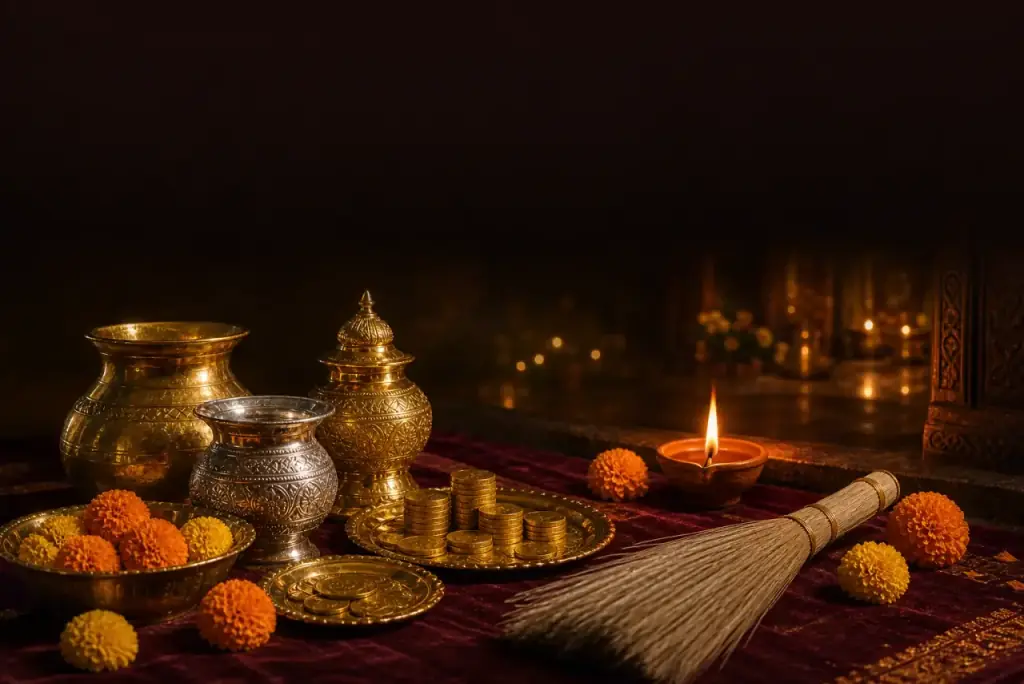
The day carries two figures. The first is Dhanvantari, the physician of the gods, who is said to have risen from the churning of the ocean (samudra manthan) carrying the pot of amrita, the nectar of life — which is why Dhanteras is also kept as a day for health and for honouring medicine and healing. Because he emerged holding a vessel, buying a new metal pot, plate or coin on this day became the custom that gives Dhanteras its modern shape.
The second figure is Yama, the god of death. At dusk many households light a single lamp facing south — the direction associated with Yama — and place it outside the door (the Yama-deepam) as a prayer to keep untimely death away from the family. So the day holds both threads at once: welcoming prosperity and asking for protection, before the lamps of Diwali are lit two nights later.
Rituals & observance
How Dhanteras is kept:
- Buying something metal — gold or silver if affordable, or simply a new steel or brass vessel or utensil — is the day's signature act, seen as inviting Lakshmi and good fortune into the home.
- The house is cleaned and the threshold marked with rangoli and small footprints, the same preparation that continues through Diwali.
- An evening Dhanvantari puja honours health and healing; in many homes Lakshmi and Kubera, the keeper of wealth, are also worshipped.
- At dusk (pradosh) a single lamp is lit facing south and set outside the main door — the Yama-deepam — offered for the household's protection.
- New purchases, coins or jewellery are placed before the deities during the evening puja before being put to use.
Regional variations
How this date is determined
Observed on the Trayodashi tithi of Kartik (Krishna paksha), reckoned by dusk (pradosh kala). Should the tithi fall across two days, tradition keeps the later day (para-viddha).
Dates are computed to astronomical precision (NASA/JPL ephemeris), in line with traditional panchang.