Naraka Chaturdashi
Lord Krishna
When it falls
The date shifts because it tracks the moon, not the Gregorian calendar.
Calculated for India (IST) using precise Panchang astronomy. Dates can shift by a day at locations far to the east or west.
The five days of Diwali
What Naraka Chaturdashi marks
Naraka Chaturdashi falls on the fourteenth tithi of the waning fortnight of Kartik (Kartik Krishna Chaturdashi), the day before Diwali. Its central story is the defeat of the demon Narakasura, who had seized the heavens and held many people captive. Krishna, with his consort Satyabhama, killed him and freed the prisoners, so the day before Diwali carries the sense of a long oppression lifting.
By tradition, Narakasura asked that his death be remembered with light and celebration rather than mourning. That is why the festival sits inside the Diwali cluster rather than apart from it, and the lamps lit on this evening lead into the main night of Diwali that follows.
The name also points to its meaning: 'Naraka' is the demon, and by extension the idea of hell or affliction, so the day is read as the clearing away of darkness and impurity before the fresh start that Diwali represents. In many homes the ritual focus is the pre-dawn bath rather than an elaborate puja, which is why it is treated as the quieter, smaller day before the big one.
Rituals & observance
Most observances happen before sunrise and again at dusk. The day is lighter than Diwali itself, with the emphasis on the ritual bath and a few lamps.
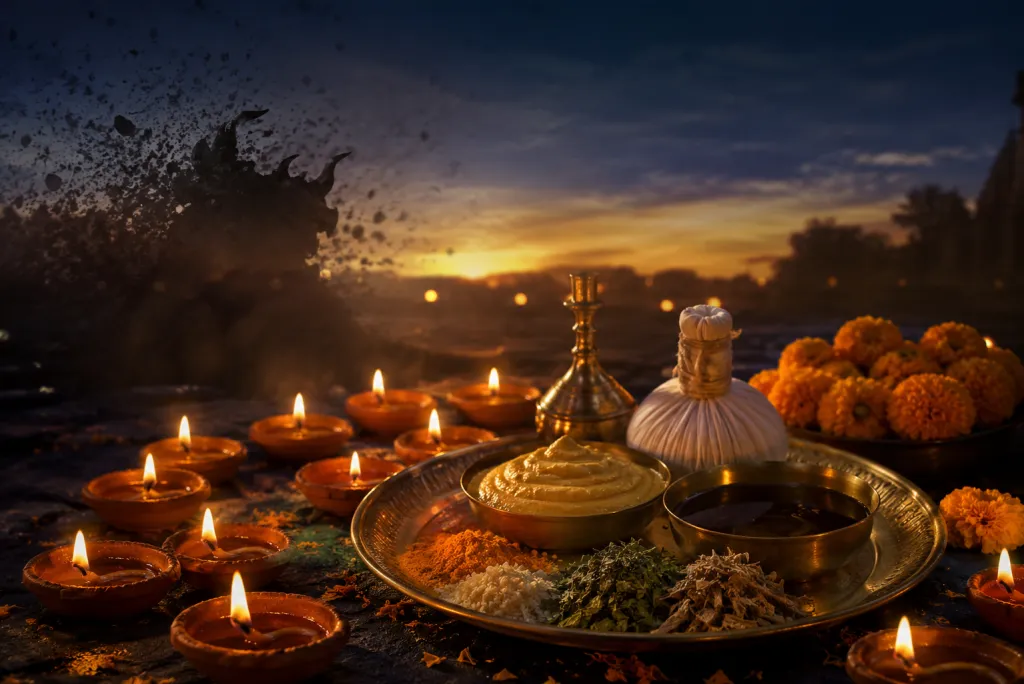
- Take the Abhyanga Snan, the ritual oil-bath before dawn — warm oil massaged in, often with ubtan (a herbal paste), followed by a bath while it is still dark. This is the defining act of the day.
- Light a few diyas at dusk (pradosh). In many homes a single lamp is placed facing south for Yama, the lord of death, as a prayer for protection from untimely death.
- Clean and tidy the home and entrance, continuing the preparation that began on Dhanteras and runs up to Diwali night.
- Wear fresh clothes after the morning bath — in some regions the day is called Roop Chaturdashi, tied to care of the body and appearance.
- Offer simple prayers to Krishna, recalling the freeing of the captives, before the larger Lakshmi Puja of Diwali the next evening.
Regional variations
How this date is determined
Observed on the Chaturdashi tithi of Kartik (Krishna paksha), reckoned by the pre-dawn moonrise. Should the tithi fall across two days, tradition keeps the earlier day (purva-viddha).
Dates are computed to astronomical precision (NASA/JPL ephemeris), in line with traditional panchang.