Govatsa Dwadashi
Kamadhenu
When it falls
The date shifts because it tracks the moon, not the Gregorian calendar.
Calculated for India (IST) using precise Panchang astronomy. Dates can shift by a day at locations far to the east or west.
The five days of Diwali
Why the cow and calf are honoured
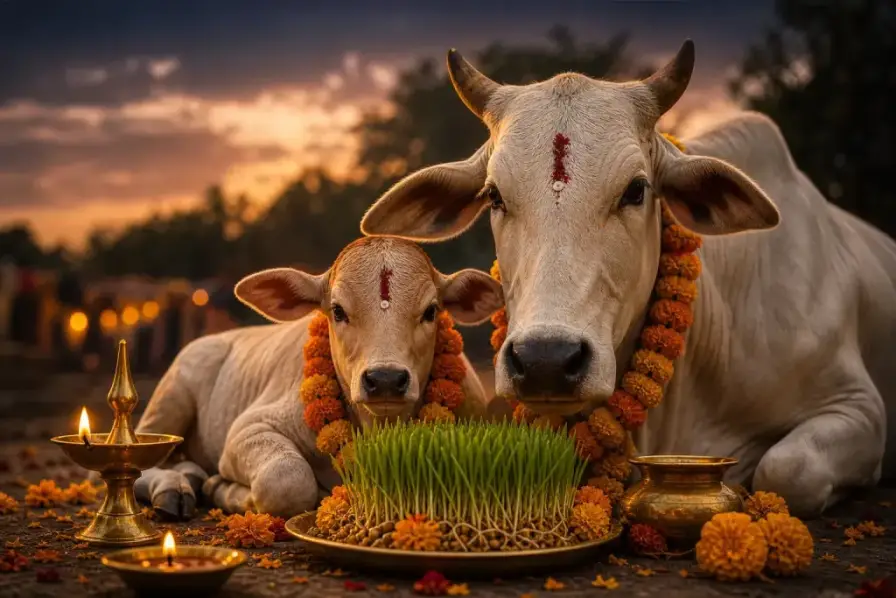
Govatsa Dwadashi is rooted in the long tradition of treating the cow as a source of life and sustenance. The cow with her calf is worshipped as a living form of Kamadhenu, the wish-fulfilling cow of myth who is said to provide whatever is needed. In a household economy that depended on cattle for milk, ploughing, and fuel, this was both a religious act and a practical acknowledgement of what the animal gives.
The calf is central to the day, not just the cow. The bond between mother and offspring is the symbol families pray on: women who keep the fast (Nandini Vrat) do so for the long life and health of their own children, asking that their care be returned the way a cow tends her calf. This is why the observance is gentle and domestic rather than grand.
The timing also matters. Falling on Kartik Krishna Dwadashi, the day sits at the front of the Diwali sequence, usually just before Dhanteras. For many families it is the first observance of the festival week, setting a tone of gratitude before the brighter celebrations that follow.
Rituals & observance
Govatsa Dwadashi is kept simply, with care for the animals at its centre. The main worship is done in the evening during pradosh (the twilight period after sunset). Common observances include:
- Bathe and clean the cow and her calf, then apply a tilak of vermilion (kumkum) and turmeric and garland them with flowers.
- Offer the cow fresh food — sprouted moong or wheat, jaggery, and grass — and feed her by hand as part of the puja.
- Women keeping the Nandini Vrat fast through the day and break it in the evening after the worship, praying for the wellbeing of their children.
- Avoid foods made from cow's milk and milk products for the day, and avoid grain cut or fried, as a mark of respect; this varies by family custom.
- Light a lamp and complete a short aarti to the cow and calf during pradosh, the preferred time for the day's worship.
Regional variations
How this date is determined
Observed on the Dwadashi tithi of Kartik (Krishna paksha), reckoned by dusk (pradosh kala).
Dates are computed to astronomical precision (NASA/JPL ephemeris), in line with traditional panchang.