Krishna Janmashtami
Lord Krishna
When it falls
The date shifts because it tracks the moon, not the Gregorian calendar.
Calculated for India (IST) using precise Panchang astronomy. Dates can shift by a day at locations far to the east or west.
Why Janmashtami is observed
Janmashtami marks the birth of Lord Krishna, counted as the eighth avatar of Vishnu. By tradition, Krishna was born at midnight in a prison in Mathura to Devaki and Vasudeva, while the king Kamsa waited to kill the child a prophecy said would end him. Vasudeva carried the newborn across the flooded Yamuna that same night to Gokul, where Krishna was raised in safety among the cowherds. The festival falls on the eighth day (ashtami) of the waning fortnight (Krishna paksha) of Bhadrapada, and many traditions also look for the Rohini nakshatra said to have accompanied his birth.
For most people the day is less about doctrine than about the figure of Krishna himself. He is the mischievous child who stole butter, the cowherd of Vrindavan, and the charioteer who delivered the Bhagavad Gita to Arjuna on the battlefield. That range lets the festival hold both play and seriousness.
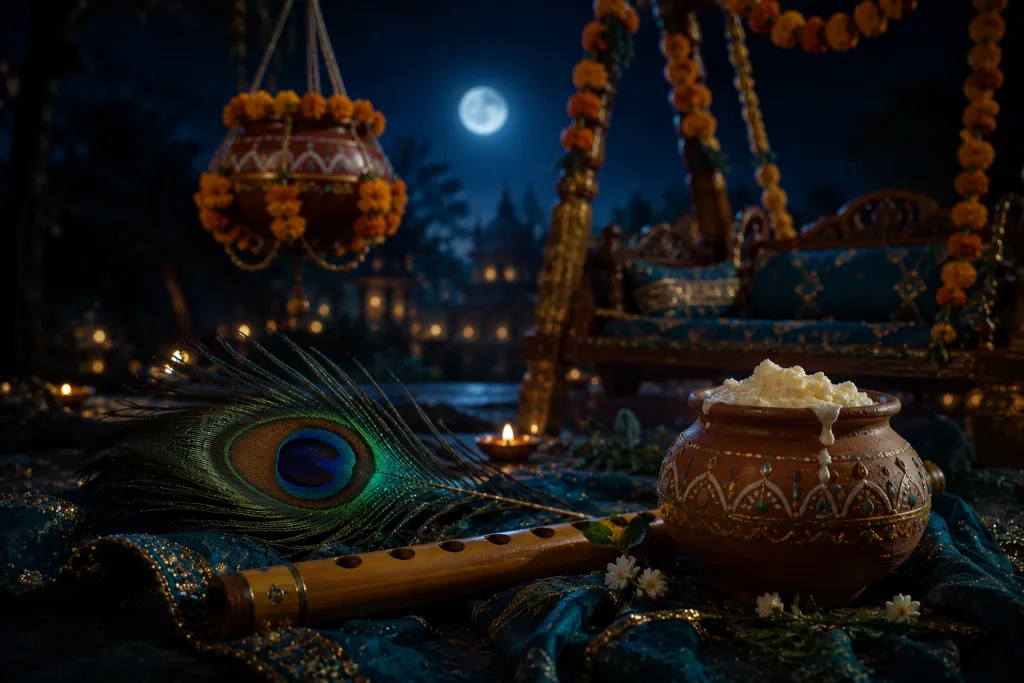
Because the worship centres on the moment of birth, the rhythm of the day is built around waiting. Devotees keep a fast and stay up until midnight, and the celebration peaks not at dawn or dusk but in the dark hours, when the image of the infant Krishna is bathed, dressed, and placed in a cradle.
Rituals & observance
Observance is shaped by the midnight birth: a day of fasting, then worship and the rocking of the infant Krishna once the hour arrives. Customs vary by region and household, but these are the common threads.
- Keep a fast through the day, usually broken only after the midnight (nishita) puja. Some hold a stricter waterless fast; many take fruit, milk, and non-grain foods through the day.
- Clean and decorate the home shrine, and prepare a small cradle (jhula) for the image of the infant Krishna.
- Perform the main puja at midnight (nishita): bathe the deity, often with milk, curd, honey, and water, dress it in fresh clothes, and offer butter, makhan-mishri, and sweets.
- Rock the cradle, sing bhajans and recount the Krishna stories, and offer panjiri or other traditional prasad before breaking the fast.
- In many cities, especially across Maharashtra and Gujarat, the next day brings Dahi Handi, where teams form human pyramids to reach and break a high pot of curd, echoing Krishna's butter-stealing childhood.
- Visit a Krishna temple if you can; Mathura, Vrindavan, and Dwarka draw large gatherings, with jhanki tableaux depicting scenes from his life.
Regional variations
How this date is determined
Observed on the Ashtami tithi of Bhadrapada (Krishna paksha), with the Moon in the 4 nakshatra, reckoned by midnight (nishita kala).
Dates are computed to astronomical precision (NASA/JPL ephemeris), in line with traditional panchang.