Rama Ekadashi
Lord Vishnu
When it falls
The date shifts because it tracks the moon, not the Gregorian calendar.
Calculated for India (IST) using precise Panchang astronomy. Dates can shift by a day at locations far to the east or west.
The five days of Diwali
What Rama Ekadashi marks
Rama Ekadashi is one of the twenty-four Ekadashis kept through the year. The eleventh lunar day (Ekadashi) of each fortnight is set aside for Vishnu, and a fast is observed on it. This one falls in the waning (Krishna Paksha) half of the month of Kartik, which places it in the days just before Diwali, so it carries the mood of that bright season.
The name here does not refer to Lord Rama. "Rama" is one of the names of Lakshmi, Vishnu's consort, and the fast is associated with her grace alongside Vishnu's. The classical accounts present it, like other Ekadashis, as a day whose merit comes from disciplined fasting and remembrance of Vishnu rather than from elaborate ritual.
Because the lunar calendar moves against the solar one, the exact date shifts each year. The Ekadashi recurs every fortnight under different names, so Rama Ekadashi is the specific Kartik Krishna Paksha observance, and the next one in the bright fortnight of the same month is Devutthana Ekadashi.
Rituals & observance
The observance is simple and centred on restraint. The fast is the main act; the worship around it is kept modest.
- Keep a fast (vrat) for the full day. Many observe it nirjala (without food or water); others take a single light meal or fruit and milk, depending on age and health.
- Avoid grains, rice, lentils (dal), and beans for the day. These are traditionally set aside on every Ekadashi.
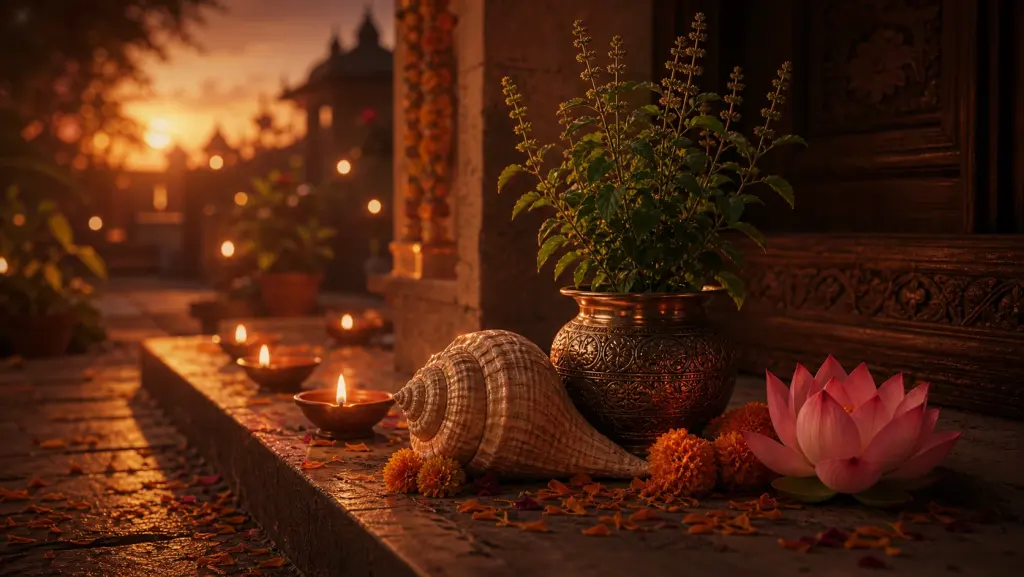
- Bathe in the morning, then offer worship to Vishnu with tulsi leaves, a lamp, and the recitation or hearing of his names.
- Spend the day quietly in remembrance, chanting, or reading, rather than in heavy activity or rich eating.
- Break the fast the next morning during the parana window, after sunrise and within the time the Ekadashi tithi has ended. Take a simple meal that includes grains to formally end the vrat.
How this date is determined
Observed on the Ekadashi tithi of Kartik (Krishna paksha), reckoned by sunrise (udaya tithi).
Dates are computed to astronomical precision (NASA/JPL ephemeris), in line with traditional panchang.