Pohela Boishakh
When it falls
The date shifts because it tracks the moon, not the Gregorian calendar.
Calculated for India (IST) using precise Panchang astronomy. Dates can shift by a day at locations far to the east or west.
Bengali spring new year
Why Pohela Boishakh matters
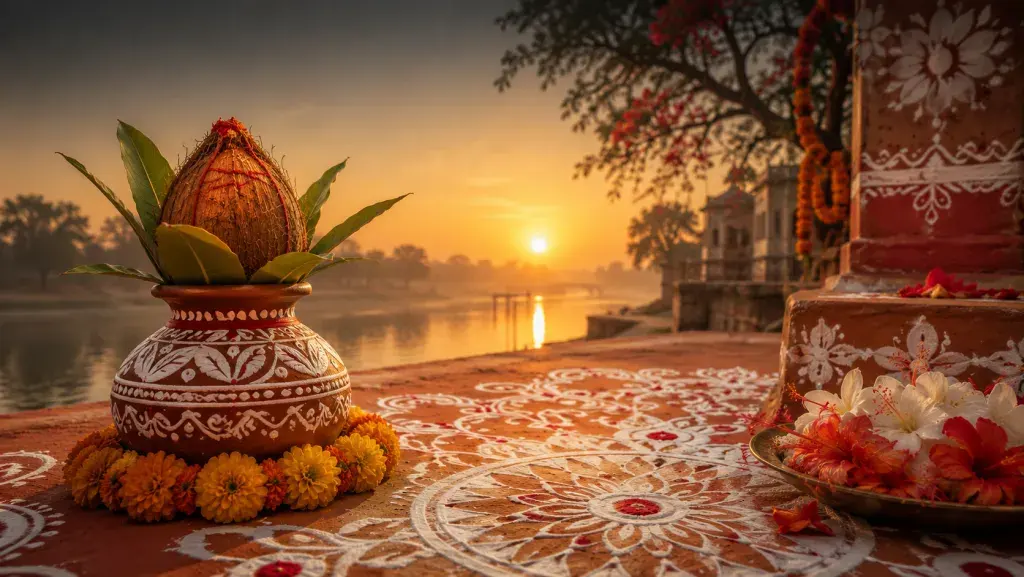
Pohela Boishakh means simply "the first of Boishakh" — the opening day of the first month of the Bengali calendar and the start of a new year, the Bangabda or Bengali era. Like several spring new-year days across India, it is a solar new year: the date is set by the Sun's entry into Aries (Mesha Sankranti) rather than a fixed day on the Western calendar, which is why it falls in mid-April each year. The Bengali New Year shares this solar timing with neighbouring spring observances such as Vishu in Kerala and Puthandu in Tamil Nadu and the harvest festivals of the season.
More than a date on the calendar, the day is a cultural milestone. It is widely celebrated as a secular, shared occasion across communities and faiths — most prominently as a national festival in Bangladesh — rather than a strictly religious rite. For families, traders, and whole neighbourhoods, it is a clean line drawn between the year that has ended and the one that begins, an invitation to start afresh.
For the business community, Pohela Boishakh carries a particular weight. The custom of Halkhata — opening a new account book — turns the new year into a practical reset: old debts are settled, a fresh ledger is begun, and customers are welcomed with sweets and good wishes for a prosperous year ahead.
Rituals & observance
Pohela Boishakh is kept with a warm mix of home customs, community gatherings, and trade traditions. The exact mix varies by place, but a few observances recur across Bengal and Bangladesh:
- Halkhata — shopkeepers and traders close the old year's accounts and open a new ledger, often with a small prayer and sweets offered to customers and visitors.
- New clothes and a tidy home — people wear fresh, often traditional dress, and homes and shops are cleaned and decorated to welcome the new year.
- A festive first meal — families share special dishes; in Bangladesh the day traditionally begins with panta bhat (soaked rice) and fried fish, while sweets and seasonal food feature widely.
- Greetings of the season — exchanging "Shubho Noboborsho" (Happy New Year) with family, friends, and neighbours.
- Cultural processions and fairs — public celebrations with music, dance, and poetry; in Dhaka the Mangal Shobhajatra procession is a major, colourful highlight of the morning.
- Visiting and gathering — families come together and visit relatives and neighbours, making the day as much about renewing ties as renewing the year.
Regional variations
How this date is determined
Observed on the sankranti, the day the Sun crosses into a new zodiac sign.
Dates are computed to astronomical precision (NASA/JPL ephemeris), in line with traditional panchang.