Neel Sasthi
Lord Shiva (Neelkantha)
When it falls
The date shifts because it tracks the moon, not the Gregorian calendar.
Calculated for India (IST) using precise Panchang astronomy. Dates can shift by a day at locations far to the east or west.
Bengali spring new year
Significance & story
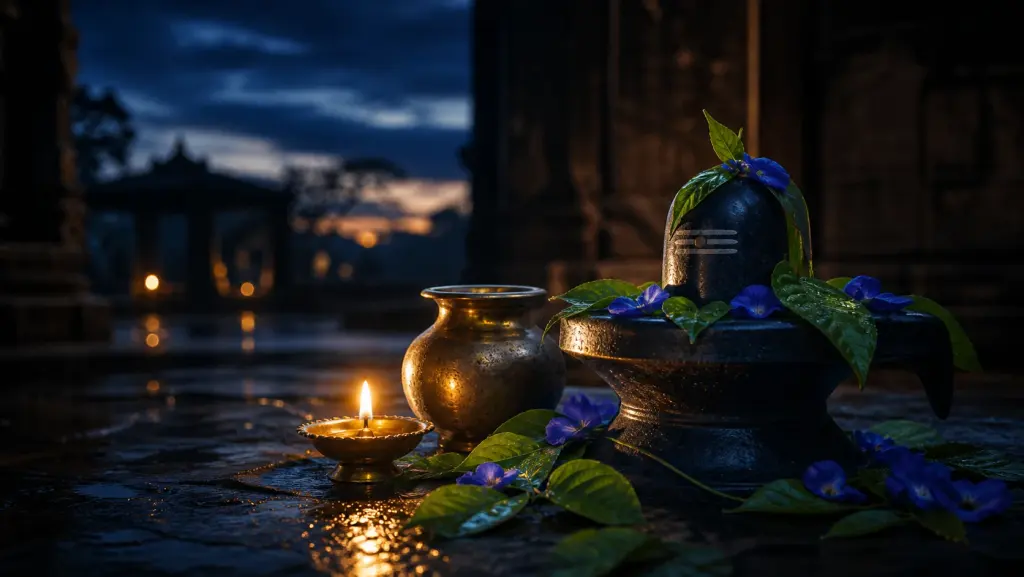
Neel Sasthi, also called Nil Sasthi or Neel Puja, is a Bengali folk observance kept in the last days of the Bengali year. It is dedicated to Lord Shiva, worshipped here in his form as Neel or Neelkantha — "the blue-throated one," a name that recalls the story of Shiva drinking the poison churned from the cosmic ocean and holding it in his throat to protect the world. The day is closely tied to Charak Puja and the larger Gajan tradition, and it falls on the eve of Charak, just before the Sun crosses into Aries (Mesha) at Choitro Sankranti.
At its heart this is a mother's vow. Mothers keep a fast and worship Shiva for the long life, health and welfare of their children — the central intention that has carried the observance through generations of Bengali households. It is not a large public festival; it is a domestic and temple observance, low-key compared with the more visible processions of Charak the next day, but quietly important to the families who keep it.
Because Neel Sasthi is fixed to the solar year rather than to a lunar tithi, it sits at the turn from the old Bengali year to the new. It marks, in a small and personal way, the same seasonal threshold that Charak Puja and the Bengali New Year (Pohela Boishakh) mark more publicly — the Sun's passage into Mesha, and with it the close of one year and the start of the next.
Rituals & observance
How Neel Sasthi is kept:
- Mothers keep a day-long fast for the wellbeing of their children, taken with varying strictness — some go without food and water, others allow fruit and non-grain foods through the day.
- Lord Shiva is worshipped as Neel (Neelkantha), at home or at a Shiva temple, with the offerings traditionally dear to him — water, milk, bel (bilva) leaves, flowers and fruit.
- The fast is broken in the evening, after the worship is complete, often with a simple non-grain meal rather than a feast.
- Many keep the day with restraint and quiet rather than celebration, in keeping with its character as a vrat (vow) made on behalf of one's children.
- It is observed in close connection with Charak Puja the following day, so households often treat the two days as a single sequence at the year's end.
Regional variations
How this date is determined
Observed on the sankranti, the day the Sun crosses into a new zodiac sign.
Dates are computed to astronomical precision (NASA/JPL ephemeris), in line with traditional panchang.