Thai Pongal
When it falls
The date shifts because it tracks the moon, not the Gregorian calendar.
Calculated for India (IST) using precise Panchang astronomy. Dates can shift by a day at locations far to the east or west.
A harvest thanksgiving timed to the Sun
Thai Pongal marks the day the Sun (Surya) moves into Capricorn (Makara) and begins its northward journey, the same astronomical moment as Makar Sankranti elsewhere in India. For Tamil families it is also the first day of the month of Thai, long held as an auspicious time to begin new things, and it lands when the main rice harvest is in. At its core, the festival is a farmer's thanksgiving for sun, rain, cattle, and a good crop.
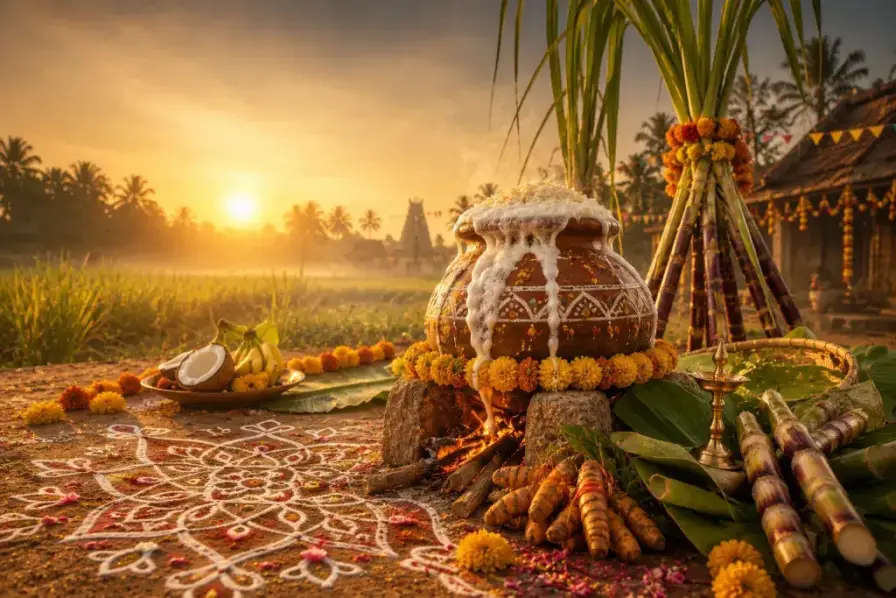
The name comes from the dish and the act at the heart of the day: pongal, freshly harvested rice cooked with milk and jaggery in a clay pot, left to boil until it bubbles up and spills over the rim. The overflow is the whole point. Calling out "Pongalo Pongal" as the pot brims is a wish for plenty to overflow into the household in the year ahead. Unlike many Hindu festivals, this one centres not on a temple deity or a mythological battle but on gratitude pointed directly at the Sun that ripened the grain.
Thai Pongal runs over four days, each with its own focus: Bhogi for clearing out the old, Surya Pongal as the main day of sun worship, Mattu Pongal honouring the cattle that work the fields, and Kaanum Pongal for visiting family. Together they move from the home, to the heavens, to the animals, to the wider family — a fair summary of what a farming community depends on.
Rituals & observance
Thai Pongal is celebrated at home rather than mainly at the temple, and the rituals are practical and hands-on. The main day's worship is usually done in the morning, while the Sun is rising, since the festival honours the Sun directly.
- Bhogi (day one): clear out and discard old or unwanted household items, often in a bonfire, to start the new month with a clean home. Many also repaint or tidy the house and cooking hearth.
- Cook the pongal: on the main day, boil the first rice of the harvest with milk and jaggery in a clay pot in the open, often facing the rising Sun, and let it overflow as everyone calls "Pongalo Pongal". The dish is then offered to Surya before the family eats.
- Draw a kolam: decorate the threshold and the cooking spot with a fresh rice-flour kolam, and tie turmeric plant and sugarcane around the pot.
- Surya worship: offer the cooked pongal, sugarcane, bananas, and coconut to the Sun (Surya) as thanks for the harvest, usually in the morning light.
- Mattu Pongal (day three): wash, decorate, and feed the cattle, garlanding their horns, in recognition of the animals that plough and pull for the farm.
- Kaanum Pongal (day four): visit relatives, share the festival food, and spend the day with extended family and neighbours.
Regional variations
How this date is determined
Observed on the sankranti, the day the Sun crosses into a new zodiac sign.
Dates are computed to astronomical precision (NASA/JPL ephemeris), in line with traditional panchang.