Charak Puja
Lord Shiva
When it falls
The date shifts because it tracks the moon, not the Gregorian calendar.
Calculated for India (IST) using precise Panchang astronomy. Dates can shift by a day at locations far to the east or west.
Bengali spring new year
Significance & story
Charak Puja is a folk festival for Lord Shiva, kept at the very end of the Bengali year. It is the climax of a longer observance called Gajan — a stretch of days in which ordinary villagers, rather than priests, take vows of devotion to Shiva, live austerely, and prepare to offer their bodies to the rite. The festival belongs to the countryside and the working communities of Bengal and eastern India more than to the temple, and that is a large part of its character.
Unlike a temple festival built around a daytime puja, Charak is defined by physical austerity (tapasya). The devotees who take the vows — known as sannyasis or bhaktas for the period — fast, bathe ritually, and during Gajan often perform demanding feats: walking on or through fire, lying on thorns or blades, and piercing the body. The reasoning the tradition gives is endurance as devotion — hardship willingly borne and offered to Shiva, rather than comfort or display. It is honest to say these practices are intense, and that some of them have drawn safety concern in modern times.
The timing carries its own meaning. Charak Puja sits on Chaitra Sankranti, the last day of Chaitra and the close of the Bengali calendar year, just before Poila Boishakh, the Bengali New Year. Marking the year's end with austerity and a turn toward Shiva — the deity associated with dissolution and renewal — fits the seam between one year and the next. Because it is tied to the solar Sankranti, the festival falls in mid-April each year, around the 13th to 15th, with the exact date set by the sun's entry into Mesha (Aries).
Rituals & observance
How Charak Puja is kept:
- During the Gajan days leading up to it, the devotees who take the vow live austerely — fasting, bathing ritually, and keeping apart from ordinary household life as sannyasis for the period.
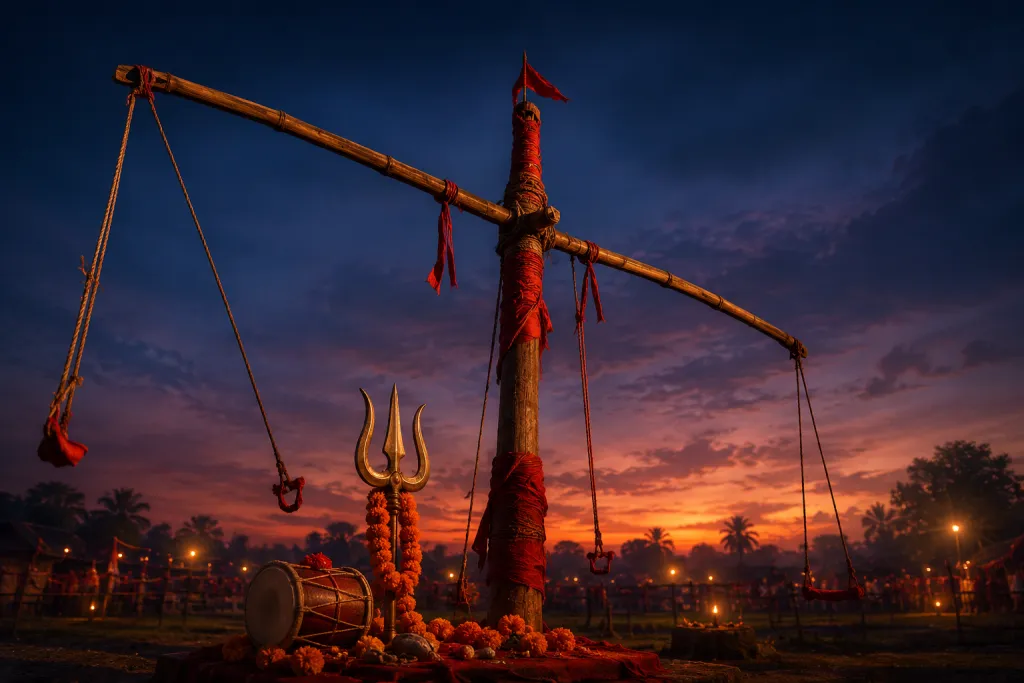
- The festival's signature rite is the charak itself: a devotee is suspended from a long horizontal beam fixed to a tall pole and swung around in wide circles while a crowd gathers below.
- Many devotees undertake bodily austerities as offerings to Shiva — common ones include fire-walking, lying on thorns or a bed of blades, and piercing the body. These are done as acts of endurance and devotion.
- The vow is broken and the fast ended only after the rite is complete, often with a final worship of Shiva.
- In many places the days carry a fair (mela) atmosphere, with stalls, folk performance and large crowds drawn to the swinging pole — part austerity, part village festival.
Regional variations
How this date is determined
Observed on the sankranti, the day the Sun crosses into a new zodiac sign.
Dates are computed to astronomical precision (NASA/JPL ephemeris), in line with traditional panchang.