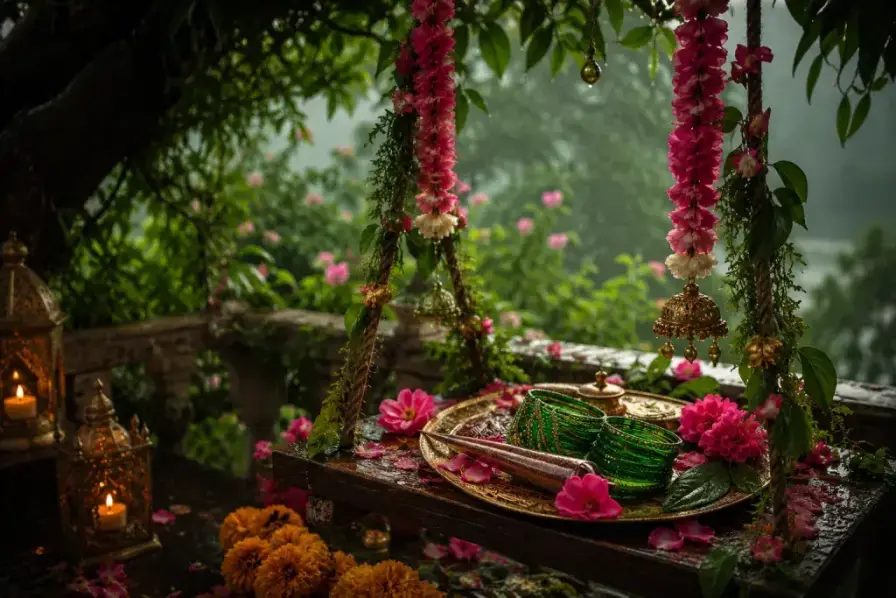
Hariyali Teej
Goddess Parvati, Lord Shiva
When it falls
The date shifts because it tracks the moon, not the Gregorian calendar.
Calculated for India (IST) using precise Panchang astronomy. Dates can shift by a day at locations far to the east or west.
The three Teej festivals
The green Teej of Shravana
Hariyali Teej takes its name from hariyali — greenery. It falls in Shravana, the heart of the monsoon, when the dry summer land has just turned green again, and the festival reads that renewal as a fitting backdrop for honouring Parvati. Women dress in green, wear green bangles, and the day carries the freshness of the season rather than the austerity of a strict vow.
Like the other Teej festivals, it remembers how Parvati won Shiva as her husband through long resolve rather than chance. Shravana Shukla Tritiya is held to be the day her devotion was finally accepted. Married women keep the day for the long life and well-being of their husbands, and unmarried women keep it hoping for a good match — but what the tradition holds up is Parvati's constancy, not a promise that the fast itself changes fate.
Of the three Teej festivals, Hariyali Teej is the gentlest and most festive. It is a monsoon celebration first — swings, songs, henna and family — with a fast woven through it. The far stricter waterless vow belongs to Hartalika Teej in the following month; Kajari Teej falls a fortnight after Hariyali. It also sits close to Nag Panchami and Raksha Bandhan, so in many homes Shravana runs as one long season of women's festivals.
Rituals & observance
The day blends a women's fast with the social warmth of the monsoon season. Customs vary by family and region, but most include the following:
- The fast: married women keep a day's fast, broken in the evening. Many keep a lighter phalahari (fruit-and-milk) fast rather than a strict waterless one, since Hariyali Teej is not traditionally a nirjala vow the way Hartalika Teej is.
- Green attire and bangles: women wear green saris or lehengas and green glass bangles, the colour of the season, often along with their wedding finery. Newly married women may receive a sindhara — gifts of clothes, sweets and bangles sent from the parental home.
- Henna (mehndi): hands are decorated with henna the day before or on the morning of Teej, one of the most recognisable customs of the day.
- Swings under the trees: decorated swings are hung from trees, and women sing traditional Teej and monsoon songs (kajri) together — the image most associated with the festival.
- Worship of Parvati and Shiva: an image or idol of Parvati (Gauri) with Shiva is honoured with flowers, vermilion and a lamp, and the Teej vrat katha is read so the reason for the day is renewed each year.
- Returning to the parental home: in many families married women go back to their mother's home for Teej, making it as much a reunion of women across generations as a religious observance.
Regional variations
How this date is determined
Observed on the Tritiya tithi of Shravana (Shukla paksha), reckoned by sunrise (udaya tithi).
Dates are computed to astronomical precision (NASA/JPL ephemeris), in line with traditional panchang.