Kajari Teej
Goddess Parvati
When it falls
The date shifts because it tracks the moon, not the Gregorian calendar.
Calculated for India (IST) using precise Panchang astronomy. Dates can shift by a day at locations far to the east or west.
The three Teej festivals
The meaning behind the day
Kajari Teej is the second of the three Teej festivals of the rainy season, coming after Hariyali Teej and before Hartalika Teej. It is also called Kajli Teej, Bhadli Teej or Satudi Teej, and like the other Teej days it is held in honour of Parvati (Gauri) and her constancy toward Shiva. Married women keep it for the well-being and long life of their husbands; in many homes unmarried women keep it too, hoping for a good match.
The name comes from kajari (or kajli), the monsoon folk songs that give the day its character. These songs, sung by women in groups to the beat of the dholak, are about the rains, separation and longing — fitting for the season when the fields are green and the festival is set. The day is read less as a request for good fortune and more as a vow of patience and devotion, in keeping with the Parvati story shared across all three Teej festivals.
Two things set Kajari Teej apart from the others. The neem tree is worshipped as a form of the Mother Goddess, and the fast is kept until moonrise rather than broken at dusk — so worship of the moon, and offerings of sattu (roasted gram flour), are central to the evening. It is a gentler, more festive observance than the strict waterless fast of Hartalika Teej a fortnight later.
Rituals & observance
The day combines a fast, worship of the neem tree and Parvati, and an evening of Kajari songs, ending after the moon is sighted. Customs vary by family and region, but most include the following:
- The fast: women fast through the day, many without food or water until the moon rises. A lighter fruit-and-milk (phalahari) version is accepted for those who cannot keep the strict form.
- Neem-tree worship: in the evening women gather at a neem tree, treated as a form of the Mother Goddess, and offer water, rice, kumkum, flowers and fruit at its base while praying to Parvati and Shiva.
- Offering sattu: sattu (roasted gram flour) is a signature offering of the day and is included in the puja and later eaten when the fast is broken.
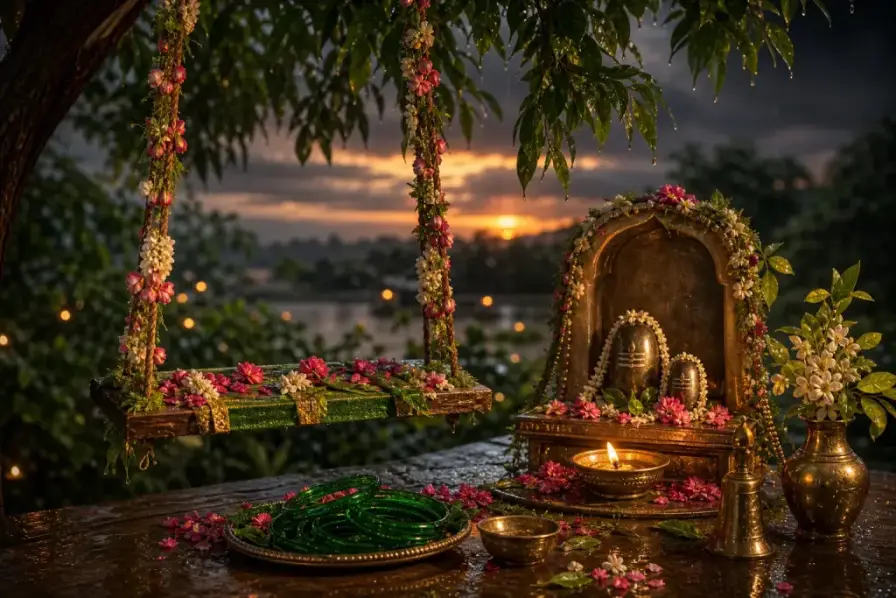
- Singing Kajari songs: women sing the monsoon kajari (kajli) songs in groups to the dholak, often while gathered around swings hung from trees.
- Moon worship and breaking the fast: the fast is broken only after the moon has risen and been offered water (arghya); the moon, not dusk, marks the end of the vow.
- Dressing up: women wear green or red, apply mehndi and sindoor, and put on bangles and wedding finery for the puja and the gathering.
Regional variations
How this date is determined
Observed on the Tritiya tithi of Bhadrapada (Krishna paksha), reckoned by sunrise (udaya tithi). Should the tithi fall across two days, tradition keeps the earlier day (purva-viddha).
Dates are computed to astronomical precision (NASA/JPL ephemeris), in line with traditional panchang.