Raksha Bandhan
When it falls
The date shifts because it tracks the moon, not the Gregorian calendar.
Calculated for India (IST) using precise Panchang astronomy. Dates can shift by a day at locations far to the east or west.
Significance & story
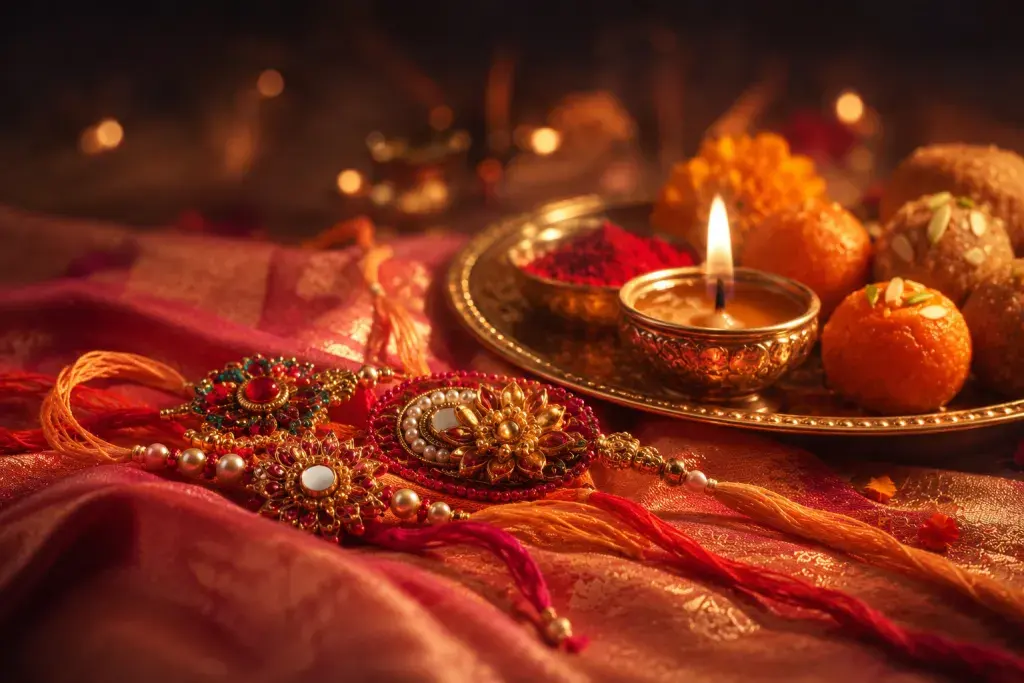
Raksha Bandhan is, at its plainest, a festival about looking out for each other. A sister ties a thread on her brother's wrist; he takes on a standing promise to protect and support her. The Sanskrit name says it directly — raksha is protection, bandhan is the tie. The thread is small, but the obligation it marks is meant to last the year.
The custom has gathered many stories around it. One often told is of Krishna and Draupadi: when Krishna's hand was cut, Draupadi tore a strip from her sari to bind the wound, and Krishna held himself bound to repay that care. The point that survives across the versions is the same — a small act of care creates a real claim on the other person, and that claim is honoured.
Over time the festival has widened well beyond blood siblings. Cousins, close family friends, and neighbours tie rakhis; in many places sisters tie them to soldiers, and the bond is read as one of community care rather than strictly family. It pairs naturally with its autumn counterpart, Bhai Dooj, the other day in the Hindu year set aside for the brother-sister relationship.
Rituals & observance
How Raksha Bandhan is kept:
- The sister performs a small aarti, applies a tilak to the brother's forehead, ties the rakhi on his right wrist, and feeds him a sweet.
- The brother gives a gift — money, clothes, or something practical — and gives his word to look out for her.
- The rakhi is tied in the afternoon (aparahna), and by tradition only after the Bhadra period has passed, so families wait for the clear window.
- Many keep a light fast until the rakhi is tied, breaking it together with sweets afterwards.
- Where siblings live apart, rakhis are posted ahead of time, and the tying is often done over a video call on the day itself.
How this date is determined
Observed on the full-moon day (Purnima) of Shravana (Shukla paksha), reckoned by the afternoon (aparahna). Should the tithi fall across two days, tradition keeps the earlier day (purva-viddha).
Dates are computed to astronomical precision (NASA/JPL ephemeris), in line with traditional panchang.