Major festival
Sankranti
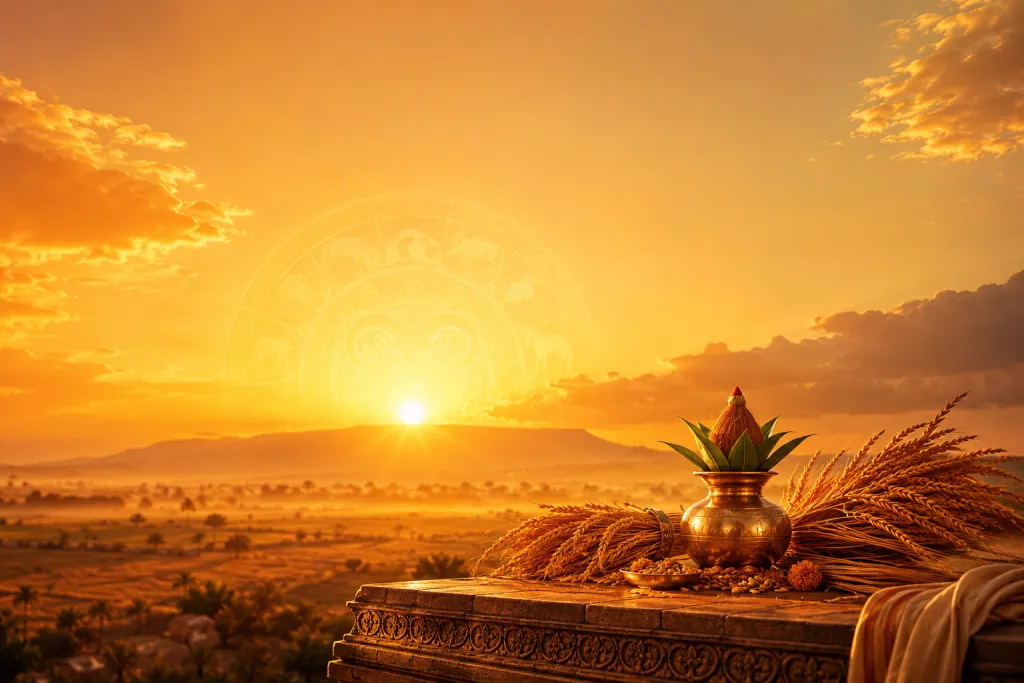
Mesha Sankranti 2027 falls on 14 April 2027. It marks the moment the Sun (Surya) enters Aries (Mesha), the first sign of the zodiac, which begins the solar year. The meritorious window for a holy bath and giving (punya kaal) opens around the moment of the Sun's ingress. Because it is tied to the Sun's position rather than the Moon, the date stays close to 13-15 April every year.
When it falls
The date shifts because it tracks the moon, not the Gregorian calendar.
Calculated for India (IST) using precise Panchang astronomy. Dates can shift by a day at locations far to the east or west.
Significance & story
Mesha Sankranti is a solar festival — Sankranti means the Sun's passage from one zodiac sign into the next. On this day the Sun (Surya) enters Aries (Mesha), the first sign of the zodiac, and that is why it is treated as the start of the solar year. The date is worked out from the Sun's actual longitude, not from a lunar phase, so it does not swing across weeks the way Moon-based festivals do; it settles near the same point in mid-April each year.
For much of India this is simply the New Year. It coincides with the main spring harvest, so it carries the double meaning of a fresh year and a thanksgiving for the crop just cut. Across regions it is kept under different names — Vaisakhi in Punjab, Pohela Boishakh in Bengal, Puthandu in Tamil Nadu, Vishu in Kerala, Bohag Bihu in Assam, and Jur Sital in parts of Bihar — but the underlying day is the same solar turn.
The hours around the ingress are considered the auspicious window (punya kaal). The acts most associated with the day are a holy bath at first light and giving to those in need (snan-daan), along with offering water to the rising Sun. The mood is one of beginning the year clean and on good terms — settling the old season and stepping into the new one with gratitude rather than ceremony for its own sake.
Rituals & observance
How Mesha Sankranti is kept:
- The core observance is a dawn holy bath (snan) in a river or sacred water-source, followed by giving (daan) — grain, clothing, water vessels or food to those in need — during the morning punya kaal around the Sun's ingress.
- Offerings of water (arghya) are made to the rising Sun (Surya), often with sesame or flowers, as a mark of gratitude at the start of the solar year.
- Many homes hold a small New Year worship, cleaning and decorating the house and beginning new account books or fresh undertakings on this day.
- Seasonal and harvest foods are cooked and shared, and in several regions an auspicious first sight (a tray of fruit, grain, gold and a mirror) is arranged so the new year opens on a prosperous note.
- Visits to a temple or a riverbank fair are common, and in farming communities the day doubles as a harvest celebration with community gatherings, dancing and song.
Regional variations
Punjab
Kept as Vaisakhi, both a spring harvest festival and a major day in the Sikh tradition, marked with fairs, folk dance and processions.
West Bengal
Observed as Pohela Boishakh, the Bengali New Year, when traders open fresh account books (halkhata) and homes welcome the year with new clothes and sweets.
Tamil Nadu
Celebrated as Puthandu, the Tamil New Year, opened with an auspicious first sight (kanni) of fruit, gold and a mirror, and a festive mixed-taste meal.
Kerala
Marked as Vishu, when the day begins with the vishukkani — a carefully arranged first sight of grain, fruit, flowers and gold — believed to set the tone for the year.
Assam
Kept as Bohag Bihu (Rongali Bihu), the Assamese New Year and spring harvest festival, celebrated over several days with feasting, music and dance.
How this date is determined
Observed on the sankranti, the day the Sun crosses into a new zodiac sign.
Dates are computed to astronomical precision (NASA/JPL ephemeris), in line with traditional panchang.
Frequently asked
What date is Mesha Sankranti in 2027?
Mesha Sankranti 2027 is on 14 April 2027.
Why does Mesha Sankranti fall in mid-April every year?
Unlike lunar festivals that move across several weeks, Mesha Sankranti is fixed to a solar event — the Sun's entry into Aries (Mesha). That ingress lands near the same calendar point each year, so the festival sits around 13-15 April and shifts forward only very slowly over centuries because of the precession of the equinoxes.
What is the punya kaal and when is it this year?
The punya kaal is the meritorious window around the Sun's ingress into Aries, considered the best time for the holy bath and for giving (snan-daan). The exact window shifts slightly each year with the moment of ingress, so check your local panchang for the day.
Is Mesha Sankranti the same as Vaisakhi, Vishu and Puthandu?
They fall on the same solar turn — the Sun's entry into Aries — and all open the regional New Year, but the names, foods and customs differ. Vaisakhi is kept in Punjab, Pohela Boishakh in Bengal, Puthandu in Tamil Nadu, Vishu in Kerala and Bohag Bihu in Assam. The shared root is the same ingress; the celebrations are local.
How is Mesha Sankranti different from Makar Sankranti?
Both are Sankrantis — days when the Sun changes sign — but they mark different ingresses.
Makar Sankranti is the Sun's entry into Capricorn (Makara) in January, which begins the northward course (Uttarayan). Mesha Sankranti is the Sun's entry into Aries (Mesha) in April, which begins the solar zodiac year.