Sheetala Ashtami
Goddess Sheetala
When it falls
The date shifts because it tracks the moon, not the Gregorian calendar.
Calculated for India (IST) using precise Panchang astronomy. Dates can shift by a day at locations far to the east or west.
The story and meaning of Sheetala Ashtami
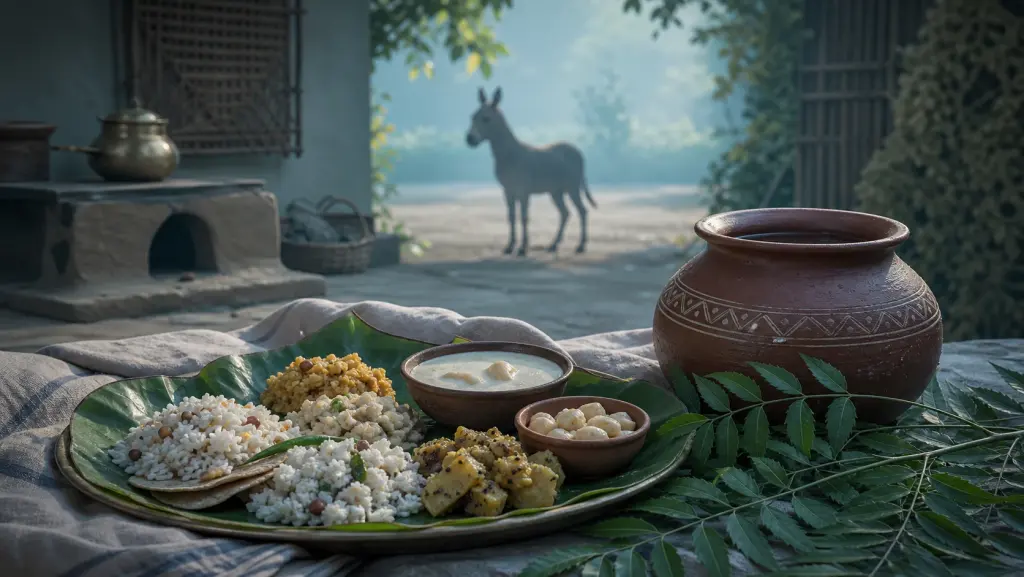
Sheetala Ashtami centres on Goddess Sheetala, a form of the Mother Goddess (Devi) long associated with healing and protection from fevers, pox and other seasonal illness. Her name means "the cool one," and she is usually pictured riding a donkey, holding a broom, a winnowing fan and a small pot of water — emblems of cleanliness, cooling and care for the sick. The festival is a request for her protection and a reminder to keep the home and body clean as the seasons change.
The observance is most closely linked to the practice that gives it its popular name, Basoda — literally "stale" or day-old food. On the day before (Saptami), households cook the family's meal; on Sheetala Ashtami itself no fresh fire is lit for cooking, and the cold, previously prepared food is offered to the goddess and then eaten by the family. The custom carries a practical memory as well as a devotional one: it falls near the turn from winter to summer, when the older tradition cautioned against heavy or freshly heated food.
On the Hindu lunar calendar Sheetala Ashtami is observed in the month of Chaitra, on Krishna Ashtami — the eighth day (ashtami) of the waning fortnight (Krishna Paksha). It comes a few days after Holi, and in several communities the days around it are kept as Sheetala Saptami and Sheetala Ashtami together. Because it is set by the lunar tithi, the calendar date moves each year.
Rituals & observance
Sheetala Ashtami is a quiet, home-centred observance built around cleanliness, an early-morning puja and the eating of cold food. Customs vary by family and region, but the core elements are widely shared:
- Cook the day before: on Saptami, the family prepares the dishes that will be offered and eaten the next day. On Sheetala Ashtami itself, the hearth is kept cold — no fresh cooking or reheating.
- Clean the home and the kitchen thoroughly, in keeping with the goddess's association with hygiene and freedom from disease.
- Wake early, bathe, and perform the puja in the morning. The day's worship is traditionally completed in the first half of the day (purvahna) rather than the afternoon.
- Offer the cold, day-old food (basoda) to Goddess Sheetala, often along with water, and then share it as the family meal.
- Visit a Sheetala temple or shrine where one is nearby; some families also offer water and light a lamp at home before her image.
- Many keep a fast through the day, eating only the cold offered food and avoiding anything freshly cooked or hot.
Regional variations
How this date is determined
Observed on the Ashtami tithi of Chaitra (Krishna paksha), reckoned by the forenoon (purvahna). Should the tithi fall across two days, tradition keeps the earlier day (purva-viddha).
Dates are computed to astronomical precision (NASA/JPL ephemeris), in line with traditional panchang.