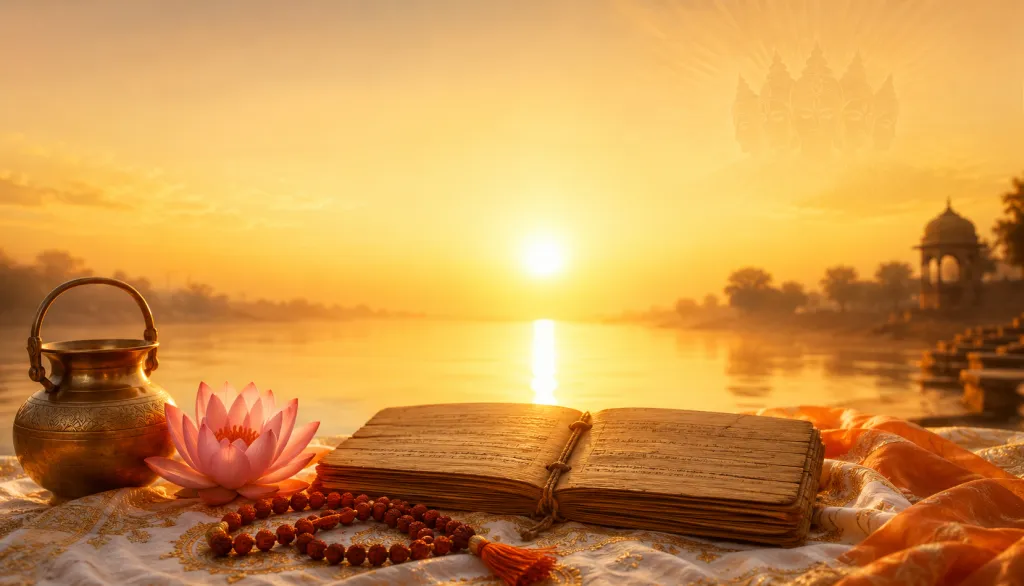
Gayatri Jayanti
Goddess Gayatri
When it falls
The date shifts because it tracks the moon, not the Gregorian calendar.
Calculated for India (IST) using precise Panchang astronomy. Dates can shift by a day at locations far to the east or west.
Who Goddess Gayatri is and why the day matters
Goddess Gayatri is the personified form of the Gayatri Mantra, one of the oldest and most revered verses in the Rigveda. She is often called the mother of the Vedas (Veda Mata), because the tradition holds that the four Vedas, and the wider body of Vedic knowledge, flow from the sound and meaning carried in her mantra. She is usually pictured with five faces and many hands, seated on a lotus, a form meant to convey her reach across the senses, the directions, and the powers of nature.
The Gayatri Mantra itself is a prayer for clear understanding. It calls on the light of the Sun (Savitr) to illuminate and guide the intellect, which is why Gayatri is tied so closely to learning, discrimination, and right thinking rather than to material reward. Gayatri Jayanti is the day set aside to honour the goddess behind that prayer, and through her, to renew one's own relationship with the mantra.
Gayatri Jayanti is most commonly observed in the month of Jyeshtha, on the Ekadashi of the bright fortnight (Shukla Paksha), placing it close to Ganga Dussehra and, in the widely followed reckoning, on the same day as Nirjala Ekadashi. The exact timing follows the lunar calendar, so the civil date shifts each year, and some regions and traditions keep it on a different day. For this reason it helps to confirm the date locally rather than assume it is fixed.
Rituals & observance
Gayatri Jayanti is kept simply and inwardly. The focus is on the mantra and on study, not on elaborate ceremony, so much of the observance can be done quietly at home.
- Bathe and sit for japa of the Gayatri Mantra, ideally facing east toward the rising Sun, since the mantra invokes the Sun's light. Many keep a count using a mala, with 108 repetitions being a common minimum.
- Offer simple worship to an image or photograph of Goddess Gayatri with a lamp, flowers, and water, and where it is the family custom, perform a small homa or havan with the mantra.
- Recite or listen to the Gayatri Mantra and related stotras through the day; some devotees observe a fast or take only light, sattvic food until the worship is complete.
- Spend time with Vedic or sacred study, even briefly, as a way of honouring Gayatri as the mother of the Vedas. Reading, teaching, or revisiting scripture suits the day well.
- Where the festival coincides with the Ganga's worship, devotees may also bathe in or remember a sacred river, linking the day to Ganga Dussehra and, by the lunar date, to Nirjala Ekadashi.
- For beginning japa or worship, sunrise and the brahma muhurta before it are traditionally considered the best times for Gayatri recitation.
How this date is determined
Observed on the full-moon day (Purnima) of Shravana (Shukla paksha), reckoned by sunrise (udaya tithi). Should the tithi fall across two days, tradition keeps the earlier day (purva-viddha).
Dates are computed to astronomical precision (NASA/JPL ephemeris), in line with traditional panchang.