Ganga Dussehra
Goddess Ganga
When it falls
The date shifts because it tracks the moon, not the Gregorian calendar.
Calculated for India (IST) using precise Panchang astronomy. Dates can shift by a day at locations far to the east or west.
Significance & story
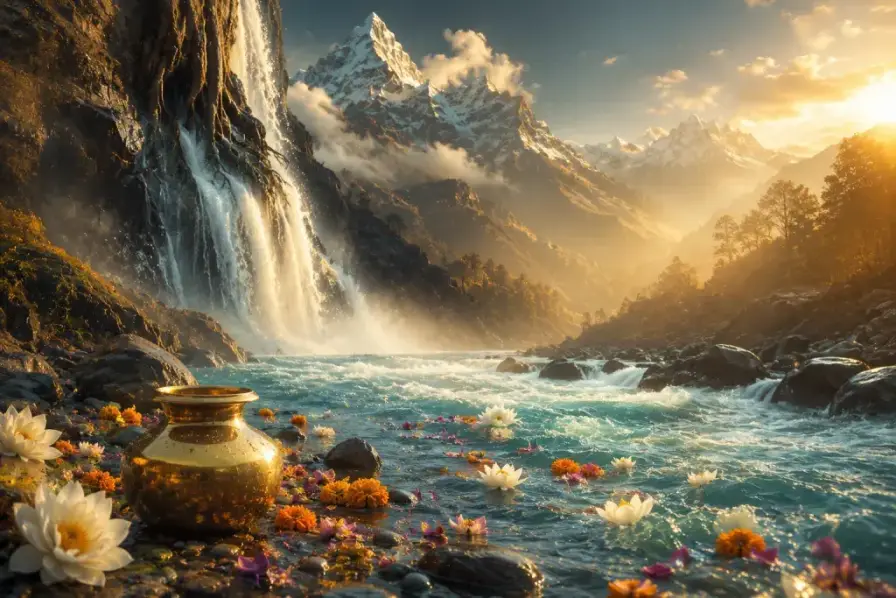
Ganga Dussehra marks the descent (avataran) of the river Ganga from heaven to earth — Gangavataran. The story behind it is the legend of King Bhagiratha, whose ancestors had been reduced to ash by a sage's curse and could find no rest. Bhagiratha's long penance finally brought Ganga down from the sky to wash over their remains and release them. Her fall would have shattered the earth, so Shiva caught the river in his matted hair and let it down gently — which is why Ganga is so closely tied to both Shiva and the idea of release from the past.
The festival reads the river as more than water: Ganga is treated as a goddess and a mother, and the day of her arrival is held to be one when bathing in her — or in any flowing river when the Ganga itself is out of reach — is especially cleansing. The name Dussehra here points to the ten (dasha) — ten lunar days, ten faults, ten sins — that the day is said to wash away. It is kept as a quiet day of purification and gratitude toward a river that much of north India still depends on for daily life.
Rituals & observance
How Ganga Dussehra is kept:
- The central act is a bath in the Ganga — or, where that isn't possible, in any river, pond or flowing water, remembering the Ganga while bathing.
- Pilgrims gather at the river ghats of Haridwar, Rishikesh, Varanasi, Prayagraj and Garhmukteshwar, where the largest crowds and aartis form.
- Worship of the goddess with flowers, lamps and milk offered to the water; many float small leaf-boats carrying a lit diya (deep daan) onto the river at dusk.
- Charity (daan) is considered especially fitting — gifts of water-vessels, hand-fans, cooling foods like melon and sattu, and shade are given to those who feel the early-summer heat.
- Reciting or hearing the legend of Bhagiratha and Ganga's descent, and chanting Ganga stotras through the day.
Regional variations
How this date is determined
Observed on the Dashami tithi of Jyeshtha (Shukla paksha), reckoned by midday (madhyahna). Should the tithi fall across two days, tradition keeps the day with the greater overlap (adhika-vyapti).
Dates are computed to astronomical precision (NASA/JPL ephemeris), in line with traditional panchang.