Gauna Devutthana Ekadashi
Lord Vishnu
When it falls
The date shifts because it tracks the moon, not the Gregorian calendar.
Calculated for India (IST) using precise Panchang astronomy. Dates can shift by a day at locations far to the east or west.
Vishnu's awakening, observed on the later Vaishnava date
The spiritual festival is Devutthana Ekadashi, the Kartik Shukla Ekadashi on which Vishnu is believed to awaken from the four-month rest of Chaturmas. Gauna Devutthana is not a second awakening and not a separate story. It is the later civil date assigned to the Vaishnava fast when an exceptional tithi-and-sunrise sequence separates it from the ordinary Smarta observance.
In the kshaya pattern represented here, Ekadashi starts after sunrise on the earlier date and finishes before the next sunrise. Since the tithi never prevails at sunrise, the normal one-date rule cannot be applied mechanically. The calendar therefore shows Devutthana Ekadashi on the earlier date and Gauna or Vaishnava Devutthana on the following date, which may also qualify as a named Mahadwadashi.
For the later observer, the day's religious meaning remains Vishnu's awakening and the close of Chaturmas. Worship of Vishnu, lamps, Ekadashi restraint and the connection with Tulasi Vivah remain relevant. What must not be borrowed from the earlier listing is the parana: the Gauna fast is broken the morning after the Gauna date, during its own local Vaishnava window.
Rituals & observance
The appearance of two adjacent dates is a choice between observance systems, not an instruction to perform two complete vrats. Use the calendar followed by your household or Vaishnava temple.
- Select the correct tradition: follow ordinary Devutthana Ekadashi if your family uses the Smarta calendar. Follow Gauna or Vaishnava Devutthana when your sampradaya assigns the later Mahadwadashi observance.
- Confirm the local date: sunrise and tithi boundaries are location-dependent. A Vaishnava date published for another city may not carry unchanged to your location, especially outside India.
- Keep the Ekadashi fast: avoid grains, beans and lentils. The strictness may range from nirjala to fruit, milk and permitted non-grain food, according to health and established practice.
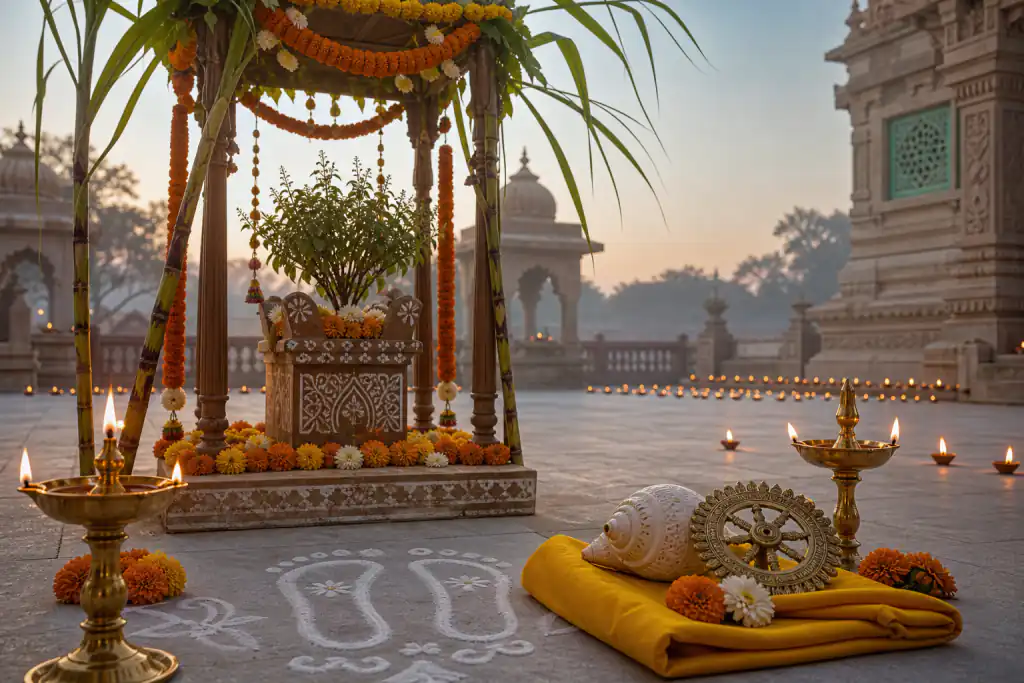
- Worship Vishnu's awakening: light lamps, offer tulsi, flowers and fruit, chant Vishnu's names and read the Devutthana Ekadashi vrata katha. Some households make a symbolic footprint or awakening arrangement according to regional custom.
- Observe the Tulsi connection carefully: Tulsi Vivah may be performed on or near this observance according to family tradition. When local custom fixes it to another nearby tithi, do not move it solely because the Gauna fast shifted.
- Break the fast on the correct morning: use the parana period following Gauna Devutthana, not the window printed for the ordinary date. If Dwadashi is short, the valid interval may be narrow, so check the city-specific panchang.
Regional variations
How this date is determined
Observed on the Ekadashi tithi of Kartik (Shukla paksha), reckoned by sunrise (udaya tithi).
Dates are computed to astronomical precision (NASA/JPL ephemeris), in line with traditional panchang.