Tulasi Vivah
Tulsi, Lord Vishnu
When it falls
The date shifts because it tracks the moon, not the Gregorian calendar.
Calculated for India (IST) using precise Panchang astronomy. Dates can shift by a day at locations far to the east or west.
Significance & story
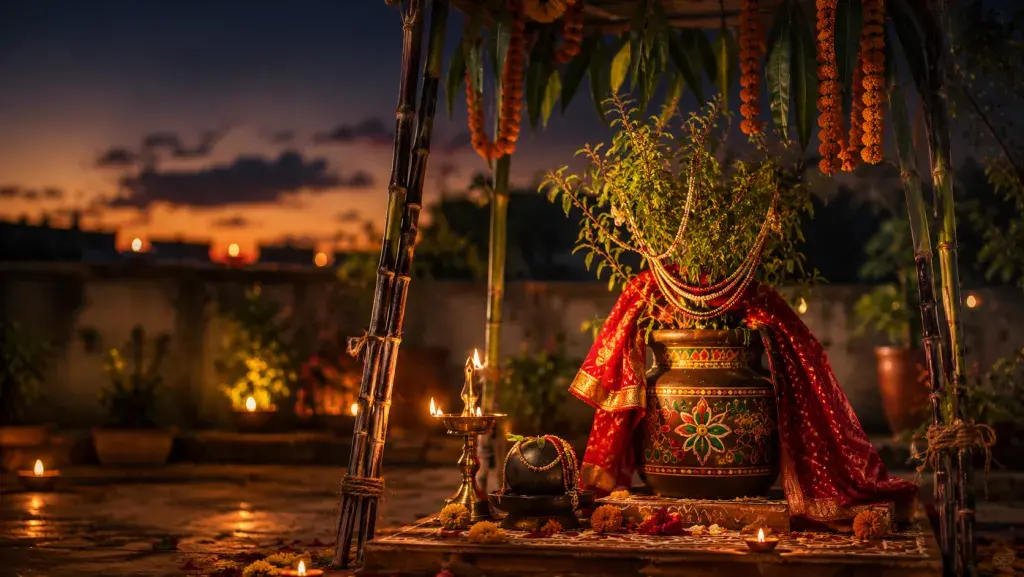
Tulasi Vivah is exactly what its name says: a wedding. The Tulsi plant (Holy Basil), grown in a pot or a small shrine outside countless Hindu homes, is honoured as Goddess Tulsi and married with full ceremony to Vishnu, usually in the form of a Shaligram stone or an image of Krishna. It is a small domestic rite performed with the seriousness of a real marriage, complete with a canopy, a wedding thread, and the chanting of vows.
The day rests on the story of Tulsi, also called Vrinda. By her devotion she had become so powerful a protector of her husband that he could not be defeated; to break that protection, Vishnu intervened, and in the events that follow Vrinda is honoured forever as the plant Tulsi, dear to Vishnu and present in his worship. From this comes the long-held rule that no offering to Vishnu is complete without a Tulsi leaf. Marrying the plant to him each year renews that bond.
The timing carries its own weight. Vishnu is said to sleep through the four monsoon months (Chaturmas), a period in which Hindu weddings are traditionally not held. He wakes on Dev Uthani Ekadashi, and Tulasi Vivah, performed in the days that follow, is treated as the first and most auspicious marriage of the season. Once it is done, the household wedding calendar is considered open again, which is why the rite is as much a social marker as a religious one.
Rituals & observance
The observance recreates a Hindu wedding in miniature, with the Tulsi plant as the bride and Vishnu (a Shaligram stone or a Krishna image) as the groom. It can be done at home or at a temple; the common elements are these:
- Clean the Tulsi pot and decorate the plant as a bride — with cloth, a small chunari (veil), bangles, vermilion (sindoor) and a bindi, and sometimes a string of flowers.
- Place the Shaligram stone or a Krishna idol beside the plant as the groom, and raise a small canopy (mandap) of sugarcane stalks over the pair.
- Perform the marriage rites — tying the auspicious thread, the exchange and chanting that stand in for the wedding vows (mangalashtaka), and the symbolic giving away of the bride (kanyadaan), often by a couple of the household.
- Offer fruit, especially amla (Indian gooseberry), along with sugarcane, flowers and sweets, and light lamps around the plant.
- Many keep a fast through the day and break it after the ceremony; the day is often paired with the Dev Uthani Ekadashi fast that precedes it.
- Conclude with aarti and the distribution of prasad, sharing the offered fruit and sweets with family and neighbours as wedding feast.
Regional variations
How this date is determined
Observed on the Dwadashi tithi of Kartik (Shukla paksha), reckoned by sunrise (udaya tithi). Should the tithi fall across two days, tradition keeps the earlier day (purva-viddha).
Dates are computed to astronomical precision (NASA/JPL ephemeris), in line with traditional panchang.