Devutthana Ekadashi
Lord Vishnu
When it falls
The date shifts because it tracks the moon, not the Gregorian calendar.
Calculated for India (IST) using precise Panchang astronomy. Dates can shift by a day at locations far to the east or west.
Why Devutthana Ekadashi matters
Like every Ekadashi, this is a fasting day (vrat) dedicated to Lord Vishnu, observed on the eleventh lunar day. What sets Devutthana Ekadashi apart is its place in the year: it falls in the bright fortnight of the month of Kartik and marks the moment Vishnu is believed to rise from his four-month cosmic sleep, the period known as Chaturmas. The name itself means the day the deity (dev) awakens (utthana).
Because Chaturmas is traditionally a time when major auspicious ceremonies are paused, Vishnu's awakening reopens the season. From this day, weddings, housewarmings, sacred-thread ceremonies and other rites are once again considered favourable. For many households this is one of the most anticipated Ekadashis of the year for exactly that reason.
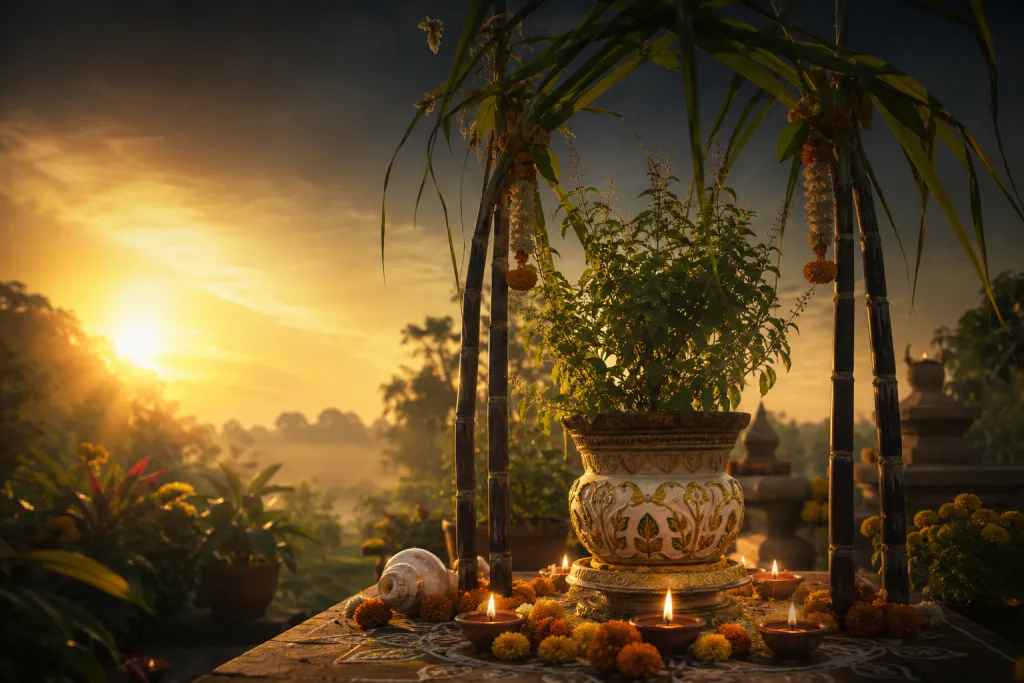
The day is also closely linked to Tulsi Vivah, the ceremonial marriage of the Tulsi (holy basil) plant to Vishnu in his Shaligram form, which is performed on or around this date. Devotees regard observing the fast and worship on this day as a way to seek Vishnu's blessings for the year's important undertakings.
Rituals & observance
Observance follows the standard Ekadashi vrat, with the awakening of Vishnu giving the day its special character. Practices vary by family and region; the core is a day of restraint and devotion to Vishnu, followed by breaking the fast the next morning.
- Begin the fast at sunrise on Ekadashi. Many keep a full fast (nirjala or waterless for the strict; others take only water, fruit and milk), while observers who cannot fast fully avoid grains, beans and rice for the day.
- Avoid grains, lentils and ordinary cooked meals; food, where taken, is kept simple and sattvic. Many also abstain from onion and garlic.
- Worship Vishnu through prayer, chanting of his names, and reading or listening to the Ekadashi story (vrat katha). Lamps are often lit in the evening to symbolically wake the deity.
- Where it is the custom, perform or attend Tulsi Vivah, the ceremonial marriage of the Tulsi plant to Vishnu, on or near this day.
- Break the fast (parana) the next morning after sunrise, within the prescribed parana window on Dwadashi, traditionally starting with Tulsi-offered prasad before a normal meal.
How this date is determined
Observed on the Ekadashi tithi of Kartik (Shukla paksha), reckoned by sunrise (udaya tithi).
Dates are computed to astronomical precision (NASA/JPL ephemeris), in line with traditional panchang.