Yamuna Chhath
Yamuna
When it falls
The date shifts because it tracks the moon, not the Gregorian calendar.
Calculated for India (IST) using precise Panchang astronomy. Dates can shift by a day at locations far to the east or west.
Significance & story
Yamuna Chhath, also known as Yamuna Jayanti, is kept as the appearance day of the river Yamuna. In tradition the Yamuna is not only a river but a goddess and a mother — she is counted as a daughter of the Sun (Surya) and the sister of Yama, the lord of death, and the same story explains the autumn festival of Bhai Dooj, when a brother visits his sister. On this day the river is honoured as a living presence rather than only as water, and the bath taken in her on her birthday is held to be especially purifying.
The day matters most in the Braj region — the country around Mathura and Vrindavan where Krishna is said to have grown up on the Yamuna's banks. For Vaishnavas, and particularly for the Vallabh (Pushtimarg) tradition, the Yamuna is closely tied to Krishna's life and to the path of devotion (bhakti); she is worshipped as Shri Yamunaji and praised in hymns composed within that lineage. So while the descent of the Ganga is recalled at Ganga Dussehra, Yamuna Chhath carries a more local, devotional weight rooted in the land where Krishna's stories are set.
It falls in early spring, in the bright fortnight of Chaitra, soon after Holi. It is a quieter observance than the large river festivals, kept more by devotees and riverside communities than across the whole country, and it should not be confused with the major autumn Chhath Puja of Bihar and eastern India, which honours the Sun god and is a separate festival despite the shared word chhath (sixth).
Rituals & observance
Observance centres on the river itself — a bath, worship of the goddess Yamuna, and often a fast. Practices vary by family and place, but the common elements are these:
- Take a bath in the Yamuna, or, where the river is out of reach, in any river or flowing water while remembering the Yamuna.
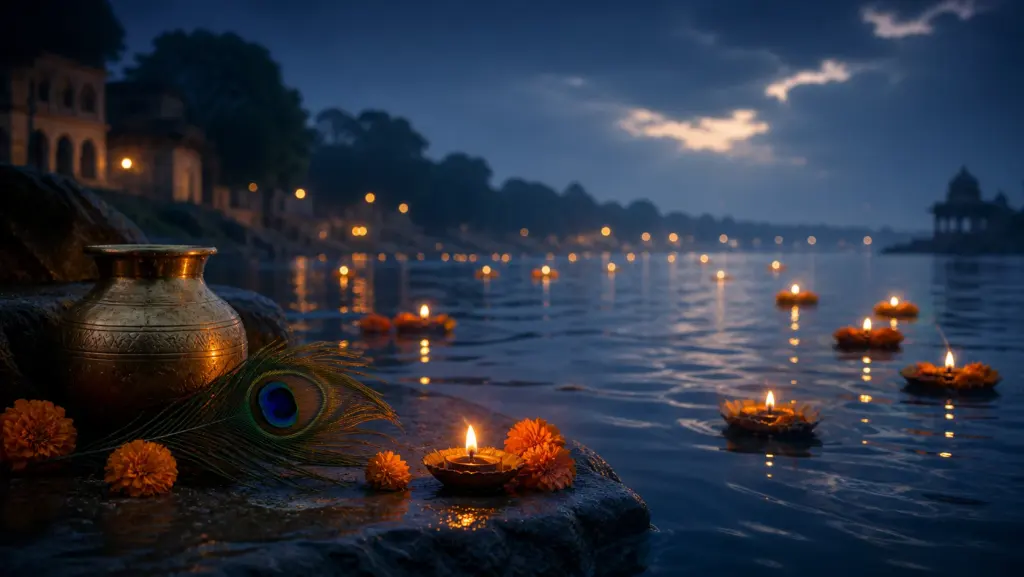
- Worship the goddess Yamuna at the river bank with flowers, vermilion (sindoor), incense, and a lamp, and offer milk, sweets, and flowers to the water.
- Keep a fast for the day; many take only fruit and water, while some keep a stricter fast and break it after the puja.
- In the Braj region, visit the ghats and temples along the river at Mathura and Vrindavan, where the day is marked with special worship and aarti.
- Recite or hear hymns and prayers to Shri Yamunaji, especially in households of the Vallabh (Pushtimarg) tradition.
- Give charity (daan) — water-vessels, food, and seasonal offerings — as a fitting act on the day.
Regional variations
How this date is determined
Observed on the Shashthi tithi of Chaitra (Shukla paksha), reckoned by sunrise (udaya tithi).
Dates are computed to astronomical precision (NASA/JPL ephemeris), in line with traditional panchang.