Chhath Puja
Surya (Sun God), Chhathi Maiya
When it falls
The date shifts because it tracks the moon, not the Gregorian calendar.
Calculated for India (IST) using precise Panchang astronomy. Dates can shift by a day at locations far to the east or west.
Significance & story
Chhath is one of the few festivals addressed directly to the Sun (Surya) and to Chhathi Maiya, regarded as a form of the goddess who protects children and looks after their wellbeing. The reasoning is plain: the sun is the visible source of warmth, harvest and health, and Chhath is the year's formal thanks for it. The festival honours both the setting sun on one evening and the rising sun the next morning — gratitude for the day that is ending before the request for the one to come.
The fast at the heart of it is demanding. The main observer (the vrati, often a woman of the household) keeps a waterless fast (nirjala) for roughly thirty-six hours, taking neither food nor water through a full day and night. There is no temple and no priest — the rite is done by the family at the water's edge, which is part of why it carries such personal weight in the communities that keep it.
It is also known for being scrupulously clean and demanding in preparation, with the offerings cooked under strict rules of purity. The mood is one of disciplined devotion rather than celebration: people return to ancestral homes and river ghats for it, and in Bihar and the eastern belt it is often described as the most important festival of the year, ahead of Diwali.
Rituals & observance
How the four days are kept:
- Day 1 — Nahay Khay: the vrati bathes, often in a river, and eats a single simple, sattvic meal to begin the period of purity.
- Day 2 — Kharna: a day-long fast broken after sunset with kheer and roti; once this meal ends, the long waterless fast (nirjala) begins.
- Day 3 — Sandhya Arghya: the family gathers at a river or pond at dusk and offers water and fruit (arghya) to the setting sun, standing in the water — the visual heart of the festival.
- Day 4 — Usha Arghya: before dawn they return to offer arghya to the rising sun; only after this is the fast finally broken (paran).
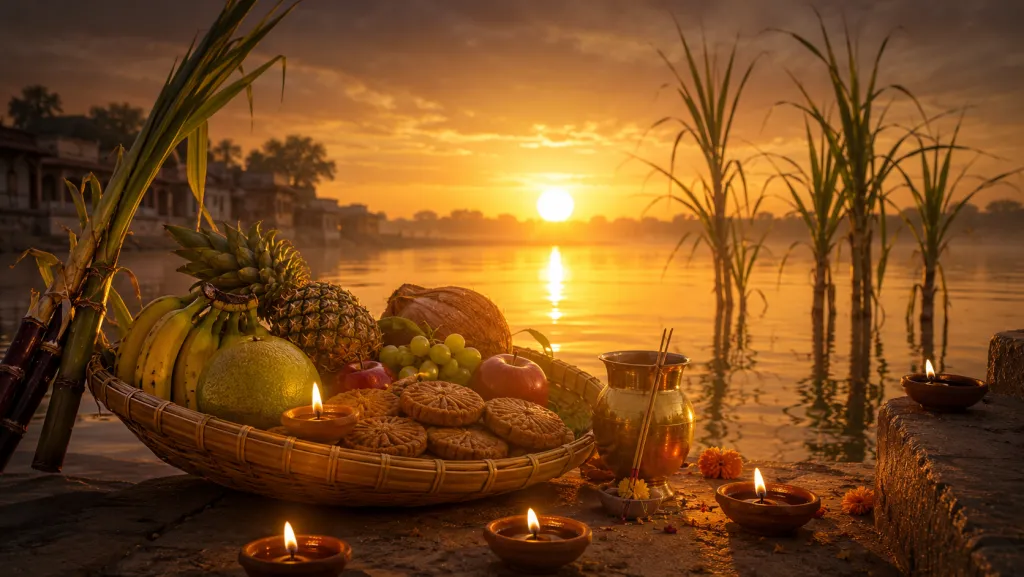
- Offerings centre on thekua (a baked wheat-and-jaggery sweet), seasonal fruit and sugarcane, carried to the water in flat bamboo trays (soop and daura).
- Folk songs to Chhathi Maiya are sung through the nights, and many walk barefoot to the ghat as part of the vow.
Regional variations
How this date is determined
Observed on the Shashthi tithi of Kartik (Shukla paksha), reckoned by sunrise (udaya tithi). Should the tithi fall across two days, tradition keeps the earlier day (purva-viddha).
Dates are computed to astronomical precision (NASA/JPL ephemeris), in line with traditional panchang.