Vat Savitri Vrat
Savitri, Satyavan
When it falls
The date shifts because it tracks the moon, not the Gregorian calendar.
Calculated for India (IST) using precise Panchang astronomy. Dates can shift by a day at locations far to the east or west.
The story behind the fast
Vat Savitri Vrat comes from the story of Savitri and Satyavan in the Mahabharata. Savitri marries Satyavan knowing he is fated to die within a year. When Yama, the lord of death, comes to take his life, she follows him and answers his questions so well that he grants her a series of boons, and through her persistence she wins back her husband's life. The fast keeps that example alive: married women observe it for the long life and health of their husbands.
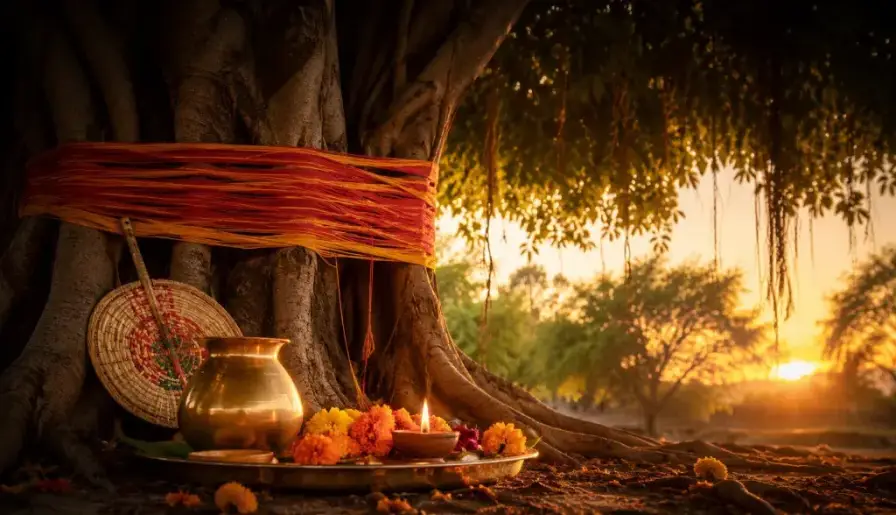
The banyan tree (vat) gives the vrat its name and is central to the day. It is long-lived and far-spreading, and in the story Satyavan's life is said to have returned to him beneath one. Women tie a thread around its trunk and walk around it while praying, tying the wish for a long married life to something living and enduring.
In North India the fast is kept on the new-moon day (Amavasya) of Jyeshtha. The same vow is honoured in the south and west of the country about a fortnight later, on the full-moon day, as Vat Purnima Vrat. The story, the tree, and the intention are the same; only the day on the calendar differs by region.
Rituals & observance
Observance centres on a day-long fast and worship of the banyan tree, usually in the midday puja window (madhyahna). Practices vary by family and region, but the common elements are these:
- Keep a fast for the day. Many women take only water or fruit; some keep a stricter waterless (nirjala) fast, and elders or those who are unwell take a lighter version.
- Visit a banyan tree (vat) for the puja, or worship a branch brought home where no tree is nearby.
- Tie a cotton or raksha thread around the tree's trunk and circumambulate it, traditionally seven times, while making the prayer for the husband's long life.
- Offer water, vermilion (sindoor), rice, flowers, and fruit at the foot of the tree, and light a lamp.
- Listen to or recite the Savitri-Satyavan story (katha), which is read aloud in many households on this day.
- Break the fast after the puja, often by sharing the offered fruit and prasad with family and other women keeping the vrat.
Regional variations
How this date is determined
Observed on the new-moon day (Amavasya) of Jyeshtha (Krishna paksha), reckoned by midday (madhyahna). Should the tithi fall across two days, tradition keeps the earlier day (purva-viddha).
Dates are computed to astronomical precision (NASA/JPL ephemeris), in line with traditional panchang.