Shani Jayanti
Shani Dev
When it falls
The date shifts because it tracks the moon, not the Gregorian calendar.
Calculated for India (IST) using precise Panchang astronomy. Dates can shift by a day at locations far to the east or west.
Who Shani Dev is and why the day is kept
Shani Jayanti marks the appearance day of Shani Dev, the deity associated with the planet Saturn (Shani). In tradition he is the son of Surya, the Sun, and Chhaya, and the brother of Yama, who presides over death and judgement. Shani is understood as the keeper of accounts: he is said to weigh a person's actions (karma) and return their results without favour. This is why he is called the giver of justice rather than a giver of misfortune.
Much of the popular fear around Shani comes from his link to slow, testing phases of life, especially the seven-and-a-half-year transit known as Sade Sati. The traditional teaching is more measured than the fear suggests: Shani brings delay, discipline, and hard lessons, and rewards patience, honest effort, and responsibility. He is hard on shortcuts and pride, and steady with those who do their work and treat others fairly. The day is kept to honour that principle, not to ward off a curse.
The festival falls on the new-moon day (Amavasya) of the month Jyeshtha, which usually lands in May or June. In North India this is the same day as the fast of Vat Savitri Vrat, so the two observances often share the calendar. Saturday is the weekday associated with Shani through the year, and his worship is heightened on this appearance day.
Rituals & observance
Observance centres on temple worship and simple offerings made to Shani Dev, with an emphasis on charity and self-restraint rather than elaborate ritual. Practices vary by family and region, but the common elements are these:
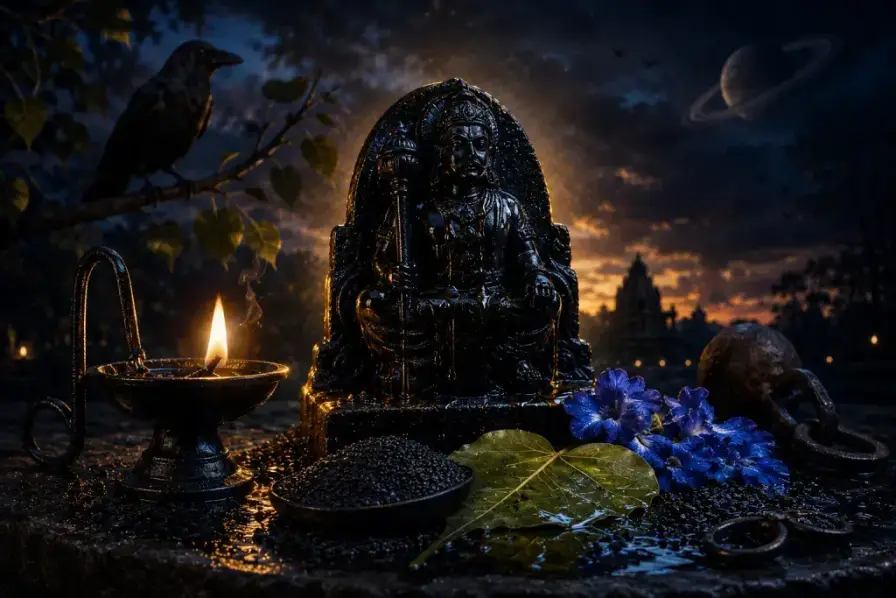
- Visit a Shani temple for darshan, where the deity is usually worshipped in the form of a black stone image, and offer prayers in the morning or on the day.
- Offer mustard or sesame oil to the image, a long-standing custom on Shani's day; many devotees light a lamp with sesame (til) oil.
- Offer black items linked to Shani such as black sesame seeds (til), black cloth, urad dal, and iron, and dress simply, often in dark colours.
- Recite or listen to prayers to Shani such as the Shani Chalisa, the Dashanam Stotra, or the Hanuman Chalisa, since Hanuman is traditionally invoked for relief from Shani's harder phases.
- Give to those in need, especially food, oil, or black sesame to the poor, workers, and the elderly, charity being considered the most fitting offering on this day.
- Keep a light fast for the day if observing, with many taking only fruit or a single simple meal, and avoid harshness, anger, and shortcuts in keeping with what the day asks for.
Regional variations
How this date is determined
Observed on the new-moon day (Amavasya) of Jyeshtha (Krishna paksha), reckoned by sunrise (udaya tithi). Should the tithi fall across two days, tradition keeps the earlier day (purva-viddha).
Dates are computed to astronomical precision (NASA/JPL ephemeris), in line with traditional panchang.