Vat Purnima Vrat
Savitri
When it falls
The date shifts because it tracks the moon, not the Gregorian calendar.
Calculated for India (IST) using precise Panchang astronomy. Dates can shift by a day at locations far to the east or west.
Why Vat Purnima is observed
Vat Purnima rests on the story of Savitri and Satyavan from the Mahabharata. Savitri chose Satyavan as her husband knowing he was fated to die within a year. When Yama, the god of death, came to take his life beneath a banyan tree, she followed him and argued with such devotion and wisdom that Yama granted her boons, through which she won back Satyavan's life. The vrat keeps that example alive: it is about steadfastness in marriage rather than any guarantee of outcome.
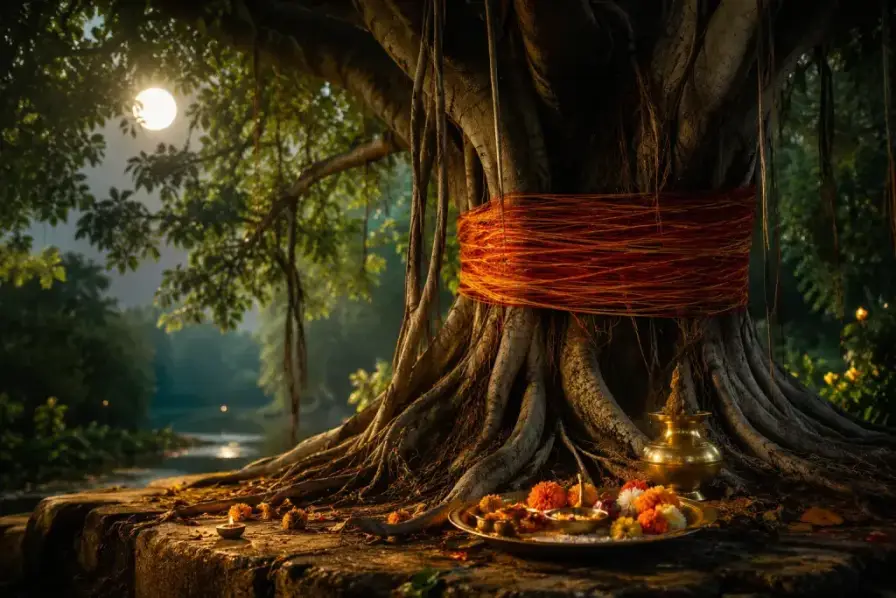
The worship centres on the banyan tree (vat), under which Satyavan was revived. The banyan is long-lived, spreads through hanging roots that take fresh hold in the ground, and stays green for generations, so it has long stood for a long life and an enduring marriage. Tying thread around its trunk and circling it is a way of asking for that same steadiness in one's own home.
This is the western and southern counterpart of the North Indian Vat Savitri Vrat. Both honour Savitri and both worship the banyan, but they fall on different days of the same month, Jyeshtha. In the north the fast is kept on the Amavasya (new moon), while in Maharashtra, Gujarat, Goa, and Karnataka it is kept about a fortnight later on the Purnima (full moon) — hence the name Vat Purnima. If your family follows the new-moon date, see Vat Savitri Vrat.
Rituals & observance
The vrat is kept mainly by married women, who fast through the day and gather at a banyan tree for the worship. Customs vary by family and region, but the core observances are these:
- Keep the fast: many women observe a full fast through the day, while others take only fruit or a single light meal. The fast is broken after the banyan worship is complete, often the next morning.
- Worship the banyan tree (vat): visit a banyan, offer water, vermilion (kumkum), turmeric, flowers, and rice at its base, and light a lamp or incense there.
- Tie the sacred thread: wind a cotton thread around the trunk while circling the tree, traditionally seven times, with the prayer for the husband's long life and a lasting marriage.
- Offer the puja items and prasad: lay out fruit, soaked gram (chana), betel, and seasonal offerings, and share them as prasad after the worship.
- Hear or recall the Savitri katha: read or listen to the story of Savitri and Satyavan, which is the heart of the day.
- Dress as a married woman (saubhagya): many wear the green or auspicious clothes, bangles, and the symbols of married status, and married elders may exchange blessings.
How this date is determined
Observed on the full-moon day (Purnima) of Jyeshtha (Shukla paksha), reckoned by midday (madhyahna). Should the tithi fall across two days, tradition keeps the earlier day (purva-viddha).
Dates are computed to astronomical precision (NASA/JPL ephemeris), in line with traditional panchang.