Shukla Pradosh Vrat
Lord Shiva
Dates in 2026
A monthly observance — here are its dates through this year.
Calculated for India (IST) using precise Panchang astronomy. Dates can shift by a day at locations far to the east or west.
Why Shukla Pradosh Vrat is kept
Pradosh refers to the short window at twilight, roughly an hour and a half around sunset, that the tradition treats as especially favourable for Shiva worship. The vrat is tied to the thirteenth lunar day (Trayodashi), which comes twice a month — once in the bright half (Shukla) as the Moon waxes toward full, and once in the dark half (Krishna). This is the bright-fortnight observance; its dark-fortnight pair is Krishna Pradosh.
Because Trayodashi falls every fortnight, Pradosh Vrat is one of the most frequent Shiva observances in the calendar, kept far more often than the once-a-year Maha Shivaratri or the monthly Masik Shivaratri. Devotees who want a regular, manageable discipline around Shiva often settle on Pradosh precisely because it returns so reliably and asks for only an evening rather than a full night.
What the vrat is traditionally said to grant is relief and steadiness rather than spectacle: removal of obstacles and accumulated wrong-doing, protection of health and family, and peace of mind. The day on which it falls is also held to carry its own emphasis — a Monday Pradosh (Som Pradosh) is linked to general wellbeing, a Saturday one (Shani Pradosh) to relief from Saturn-related difficulty — but the core act, worship of Shiva at dusk, stays the same whichever weekday it lands on.
Rituals & observance
The vrat centres on the pradosh window at dusk; the daytime fast is preparation for that evening worship. The exact pradosh timing shifts with sunset, so check the local muhurat for your place rather than a fixed clock time.
- Keep a fast through the day. Many observe it nirjala (without water) or take only fruit and milk; a lighter fast that simply avoids grains and heavy meals is also accepted, depending on your health and custom.
- Bathe and clean the worship space in the late afternoon, before the pradosh window opens, so you are ready when dusk arrives.
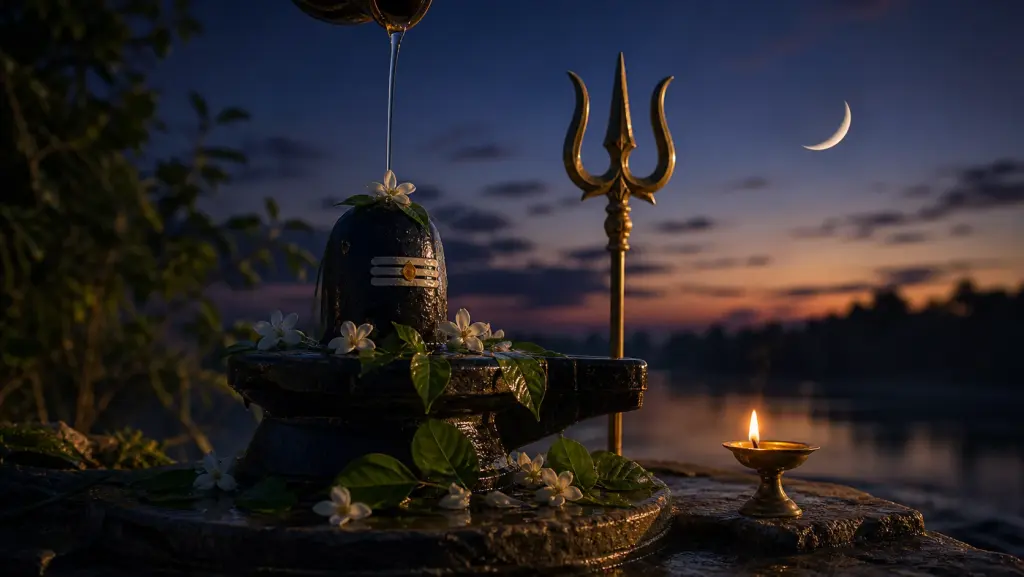
- Perform the main worship in the pradosh kaal, the roughly ninety-minute window around sunset. Offer water, then bel (bilva) leaves, to a Shiva linga or image — bel is the leaf most associated with Shiva.
- Do abhishek, bathing the linga with water, and where custom allows milk, honey or curd, while reciting Shiva mantras such as Om Namah Shivaya or the Mahamrityunjaya mantra.
- Light a lamp, offer incense and white flowers, and read or listen to the Pradosh Vrat katha (the story attached to the observance) before concluding the puja.
- Break the fast after the evening worship is complete, traditionally with simple sattvic food.
How this date is determined
Observed on the Trayodashi tithi, reckoned by dusk (pradosh kala).
Dates are computed to astronomical precision (NASA/JPL ephemeris), in line with traditional panchang.