Krishna Pradosh Vrat
Lord Shiva
Dates in 2026
A monthly observance — here are its dates through this year.
Calculated for India (IST) using precise Panchang astronomy. Dates can shift by a day at locations far to the east or west.
Significance & what the vrat is for
Pradosh Vrat takes its name from pradosh kaal — the short window of dusk around sunset, traditionally counted as the period just before and after the sun goes down. The whole observance is built around that hour: the fast is kept through the day, but the worship is timed to the moment when day turns to night, which is held to be Shiva's favoured time. "Krishna" Pradosh simply means the one that falls in the dark (waning) fortnight, as against the Shukla Pradosh of the bright fortnight.
Because the Trayodashi (thirteenth tithi) arrives once in each fortnight, Pradosh comes round about twice a lunar month. Many keep both; others keep only the one that lands on a weekday they associate with Shiva, since the day of the week is thought to shade what the vrat is kept for — Monday Pradosh (Soma Pradosh) for general wellbeing, Tuesday (Bhauma Pradosh) for relief from debt and health worries, Saturday (Shani Pradosh) for the easing of Saturn-related difficulties, and so on. The dusk timing and the linga worship stay the same; only the intention attached to the day shifts.
Tradition treats the vrat as kept for Shiva's grace in a practical sense — steadiness in the household, relief from accumulated worry and ill health, and the clearing of obstacles rather than any single dramatic boon. It is a modest, repeatable observance, not a once-a-year festival. Maha Shivaratri is the great annual Shiva night; Pradosh is the quiet fortnightly turn of the same devotion, which is part of why so many keep it regularly through the year. As with any vrat, the result is understood to follow from the discipline of keeping it consistently, not from a one-time performance.
Rituals & observance
How Krishna Pradosh Vrat is kept:
- Most observers keep a day-long fast, taken with varying strictness — some go without food and water until the evening puja, others allow fruit, milk and non-grain food through the day. The fast is usually broken after the dusk worship, not at midday.
- The puja is timed to the pradosh kaal, the dusk window around sunset rather than the morning, which shifts through the year.
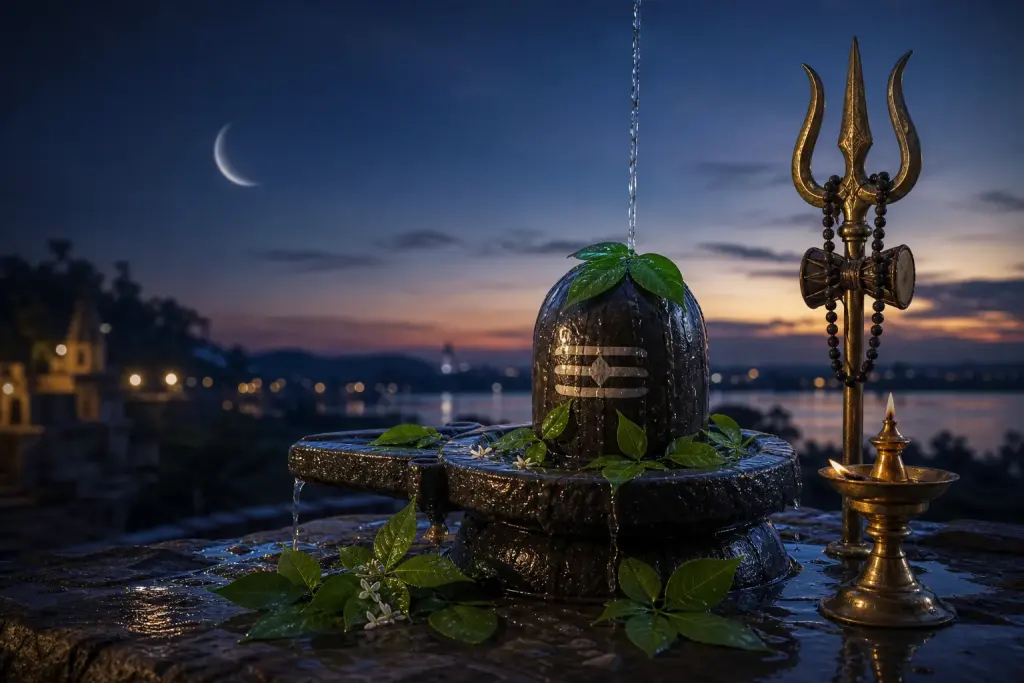
- The Shiva linga is bathed in an abhishekam — water, milk, curd, honey and ghee — and offered bel (bilva) leaves, which are held especially dear to Shiva.
- A lamp is lit at dusk and "Om Namah Shivaya" is chanted; many recite or listen to the Pradosh Stotra or the Shiva Chalisa during the evening sitting.
- Those who keep the vrat for a specific concern note the weekday it falls on — for example Saturday (Shani Pradosh) or Monday (Soma Pradosh) — and add the relevant prayers, while keeping the core dusk worship of Shiva unchanged.
Regional variations
How this date is determined
Observed on the Trayodashi tithi, reckoned by dusk (pradosh kala).
Dates are computed to astronomical precision (NASA/JPL ephemeris), in line with traditional panchang.