Masik Shivaratri
Lord Shiva
Dates in 2026
A monthly observance — here are its dates through this year.
Calculated for India (IST) using precise Panchang astronomy. Dates can shift by a day at locations far to the east or west.
Significance & story
Masik Shivaratri means the "monthly night of Shiva" (masik = monthly). It is the same observance as the great annual Shivaratri, kept in a quieter form once every lunar month. Each lunar month has a Shivaratri on the fourteenth day of its waning fortnight (Krishna Chaturdashi); the one in the month of Phalguna is celebrated grandly as Maha Shivaratri, and the eleven others through the year are observed as Masik Shivaratri.
It is, by design, a recurring vrat rather than a one-time festival. People who keep it do so as a steady monthly discipline — a regular night set aside for Shiva, often taken up for a fixed number of months or as a lifelong practice. The mood is devotional and inward rather than festive: there is no public celebration, feasting, or large gathering attached to it, only the fast and the worship.
Astronomically it sits on the fourteenth tithi of the waning moon, the night before the new moon (Amavasya), when the moon is almost gone. As with Maha Shivaratri, the tradition treats this near-darkness as a fitting setting for night worship and inner attention. Because it follows the lunar calendar, each month's Masik Shivaratri falls on a different Gregorian date, moving with the tithi rather than the solar month.
Rituals & observance
How Masik Shivaratri is kept:
- Observers keep a day-long fast (vrat), taken with varying strictness — some go without food and water, while others allow fruit, milk and non-grain foods through the day.
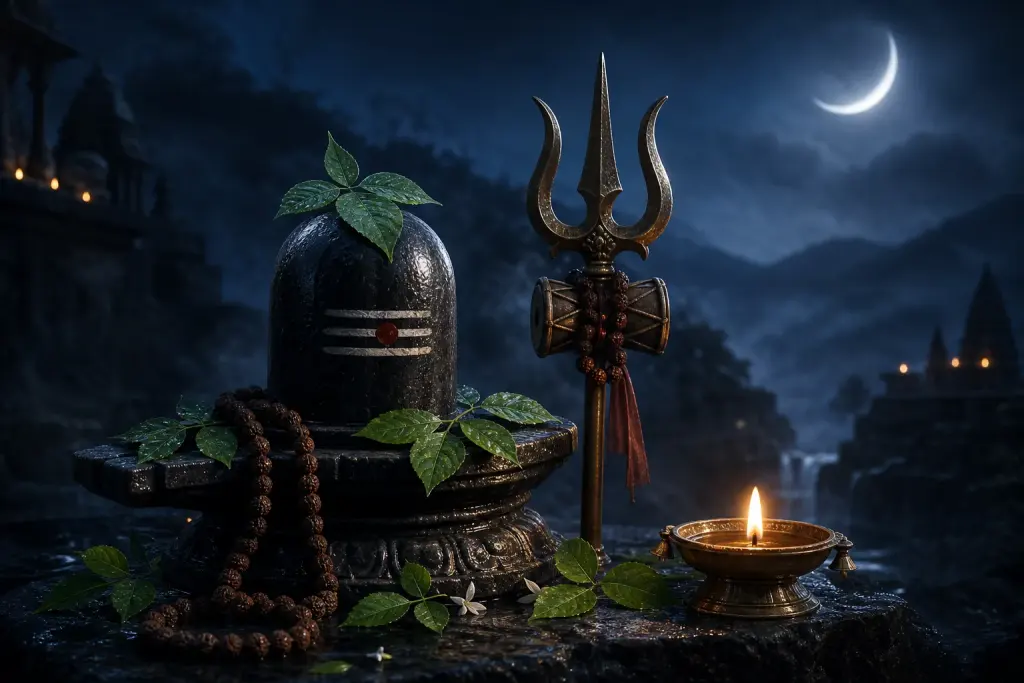
- The Shiva linga is bathed in an abhishekam — water, milk, curd, honey and ghee poured over it — and offered bel (bilva) leaves, which are held especially dear to Shiva.
- The main worship is done at night, with the principal puja at the midnight Nishita Muhurta, whose exact span depends on local sunset and sunrise; check the night's panchang for the window.
- Many keep a night vigil (jagran), staying awake to chant "Om Namah Shivaya" and recite or listen to Shiva stotras, keeping a lamp lit.
- Some take up Masik Shivaratri as an ongoing vow, observing it every month for a set period or for life rather than as a single occasion.
- The fast is broken the next morning, after the night's worship is complete.
Regional variations
How this date is determined
Observed on the Chaturdashi tithi, reckoned by midnight (nishita kala).
Dates are computed to astronomical precision (NASA/JPL ephemeris), in line with traditional panchang.