Major festival
Sankranti
Makar Sankranti 2027 falls on 15 January 2027. It marks the moment the Sun (Surya) crosses into Capricorn (Makara) and turns northward (Uttarayan). The most meritorious window for a holy bath and giving (punya kaal) opens around the moment of the Sun's ingress. Unlike lunar festivals, this is a solar date, so it stays close to 14-15 January every year.
When it falls
The date shifts because it tracks the moon, not the Gregorian calendar.
Calculated for India (IST) using precise Panchang astronomy. Dates can shift by a day at locations far to the east or west.
Significance & story
Makar Sankranti is one of the few Hindu festivals tied to the Sun rather than the Moon. Sankranti means the Sun's passage from one zodiac sign into the next; on this day it moves into Capricorn (Makara) and begins its six-month northward course (Uttarayan). In plain terms, this is the point in the year when the days start lengthening again — the cold deepens for a while yet, but the light is returning.
Because it falls with the main winter harvest across much of India, it is at heart a harvest thanksgiving. The new crop, especially sesame (til) and jaggery (gur), is offered, shared and eaten — sweets made of the two are the signature of the day, given with the gentle line til-gud ghya, god god bola (take this sweet and speak sweetly). It is a festival of settling old friction and starting the season on good terms.
The day is also treated as a turning point for spiritual effort. Uttarayan is traditionally seen as the more auspicious half of the year, and bathing in a river at first light and giving to those in need (snan-daan) are the acts most associated with it. In the Mahabharata, Bhishma is said to have waited for this northward turn before leaving his body, which is why the day carries the sense of an auspicious threshold rather than just a harvest break.
Rituals & observance
How Makar Sankranti is kept:
- The core observance is the dawn holy bath (snan) in a river or sacred water-source, followed by giving (daan) — typically sesame, jaggery, blankets, grain or khichdi to those in need — during the morning punya kaal.
- Offerings of water (arghya) are made to the rising Sun (Surya), often with sesame seeds, as a mark of gratitude for the returning light.
- Sweets of sesame and jaggery (til-gud) are made and exchanged with the words til-gud ghya, god god bola — a deliberate gesture of mending relationships and speaking kindly.
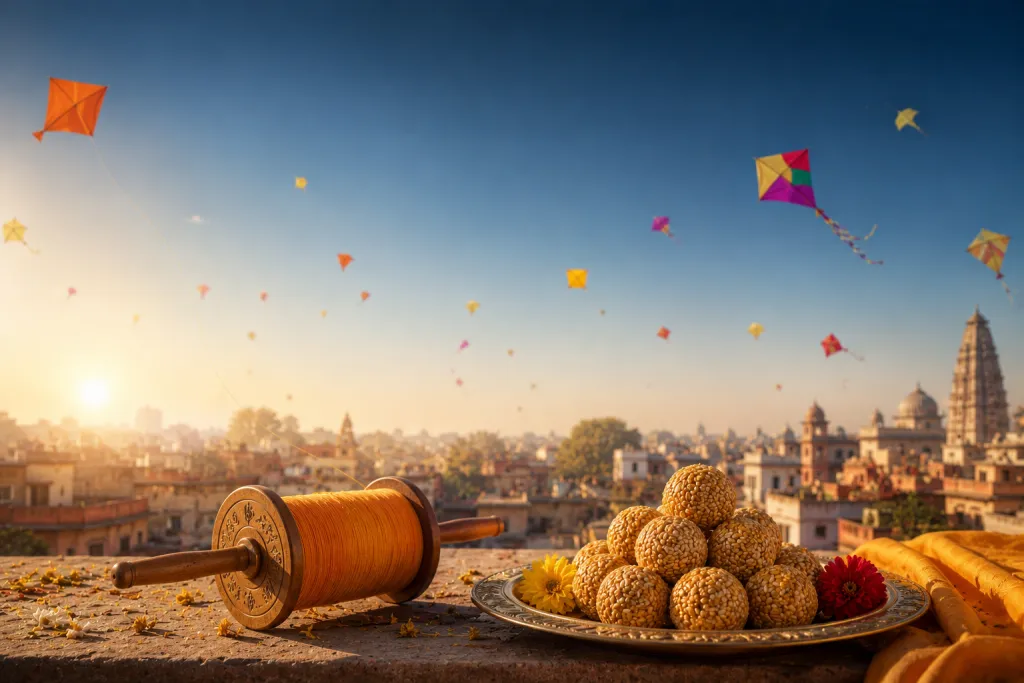
- Kite-flying through the bright winter day, strongest in Gujarat and parts of the north, marks the festival as much as any rite.
- In many homes a simple khichdi of rice and lentils is cooked and shared — so much so that the day is simply called Khichdi across the Hindi belt.
Regional variations
Tamil Nadu
Kept as Pongal, a four-day harvest festival named for the dish of freshly harvested rice boiled with milk and jaggery until it brims over — an image of plenty. Surya is honoured on the main day (Thai Pongal).
Punjab & Haryana
Marked as Lohri on the eve, gathered around a bonfire into which sesame, jaggery and popcorn are offered, with folk songs and dancing — the harvest welcomed with fire rather than water.
Gujarat
Celebrated as Uttarayan and known above all for kite-flying, when the winter sky fills with kites from morning to night and the rooftops stay busy through the day.
Assam
Observed as Magh Bihu (Bhogali Bihu), a harvest feast with community bonfires (meji) and large shared meals to close the cutting season.
How this date is determined
Observed on the sankranti, the day the Sun crosses into a new zodiac sign.
Dates are computed to astronomical precision (NASA/JPL ephemeris), in line with traditional panchang.
Frequently asked
What date is Makar Sankranti in 2027?
Makar Sankranti 2027 is on 15 January 2027 in India.
Why does Makar Sankranti almost always fall on 14 or 15 January?
Unlike lunar festivals that swing across weeks, Makar Sankranti is fixed to a solar event — the Sun's entry into Capricorn (Makara). That ingress lands near the same calendar day each year, so the festival sits on 14 or 15 January and drifts forward only very slowly over centuries because of the precession of the equinoxes.
What is the punya kaal and when is it this year?
The punya kaal is the meritorious window around the Sun's ingress, considered the best time for the holy bath and for giving (snan-daan). The exact window shifts slightly each year with the moment of ingress, so check your local panchang for the day.
Is Makar Sankranti the same as Pongal, Lohri and Uttarayan?
They are closely linked but not identical. Pongal in Tamil Nadu and Uttarayan in Gujarat fall on the same solar turn and share the harvest theme. Lohri in Punjab is kept the evening before, around a bonfire. The names, foods and customs differ by region, but all mark the same shift toward the northward sun.
Why is Uttarayan considered auspicious?
Uttarayan is the half of the year when the Sun travels northward and the days lengthen. Tradition treats this brighter, ascending phase as the more favourable time for spiritual practice, charity and important beginnings — which is why bathing, giving and starting fresh are central to the day.