Jaya Ekadashi
Lord Vishnu
When it falls
The date shifts because it tracks the moon, not the Gregorian calendar.
Calculated for India (IST) using precise Panchang astronomy. Dates can shift by a day at locations far to the east or west.
What Jaya Ekadashi marks
Jaya Ekadashi is the Ekadashi — the eleventh lunar day (tithi) — of the waxing fortnight (Shukla Paksha) in the month of Magha, which falls around late January or February. Like every Ekadashi, it is a fast dedicated to Vishnu, but each named Ekadashi in the year carries its own story and emphasis. Jaya means victory, and the day is associated with overcoming what holds a soul back.
The classical account tied to this day, told in the Puranas, is the release of a celestial couple who were cursed into restless, ghostly existence (pretatva) and freed by the merit of this fast. For that reason Jaya Ekadashi is widely observed with the departed in mind: families keep the vrat and dedicate its merit to ancestors, in the hope of easing their onward journey. Beyond that, it is kept for the usual reasons one keeps an Ekadashi — clearing accumulated wrong, steadying the mind, and devotion to Vishnu.
There is one Ekadashi in each lunar fortnight, so two each lunar month and roughly twenty-four across the year (with an extra pair in a leap month). Jaya Ekadashi is the Magha bright-fortnight one in that cycle, sitting between Shat Tila Ekadashi in the preceding fortnight and Vijaya Ekadashi in the month that follows.
Rituals & observance
The observance follows the standard Ekadashi pattern: a day of fasting and worship of Vishnu, followed by parana — breaking the fast — the next morning. Practice varies by family and region; keep to what your tradition and health allow.
- Begin the fast at sunrise on Ekadashi. Many keep a full (nirjala or waterless) fast; others take a single fruit-and-milk meal (phalahar). Grains, beans, and rice are avoided for the day — abstaining from grain is the defining rule of an Ekadashi fast.
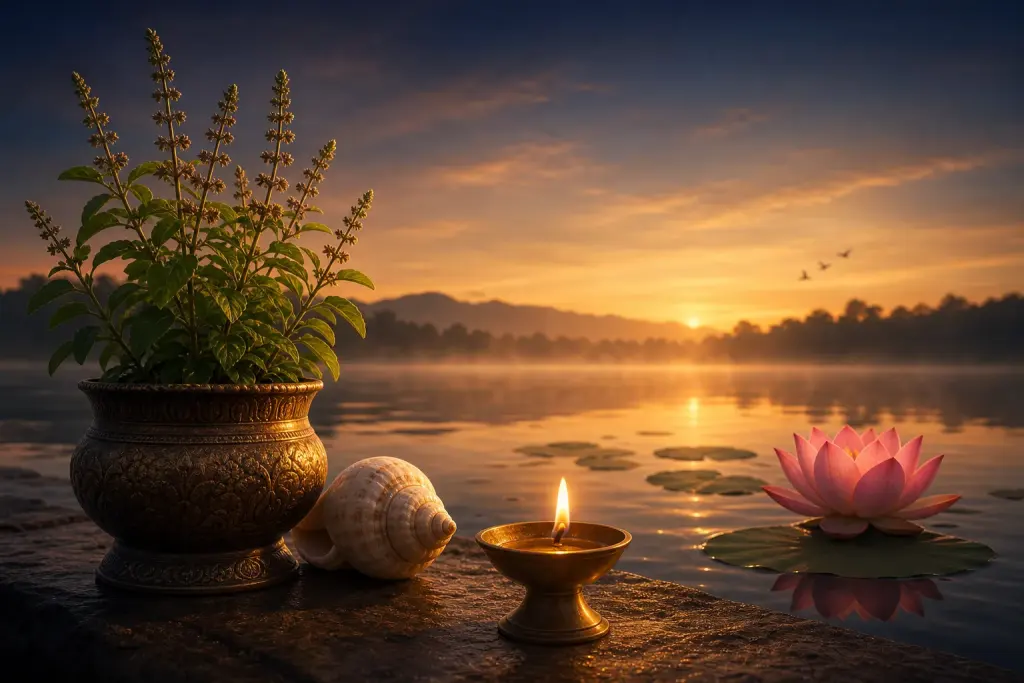
- Worship Vishnu. Bathe, then offer water, flowers, tulsi leaves, and a lamp to Vishnu, and read or hear the Jaya Ekadashi story (katha). Reciting Vishnu's names or the Vishnu Sahasranama is common.
- Dedicate the merit to ancestors. Because this day is linked to freeing the departed from restless states, many offer the fast's merit to forebears and make a small charitable gift (daan) in their name.
- Keep a watchful night (jagran). Staying awake in devotional singing and remembrance of Vishnu through the night is a traditional part of the heightened observance, though not required of everyone.
- Break the fast at parana the next morning. On Dwadashi (the twelfth day), after sunrise and within the prescribed parana window — and never during the Ekadashi tithi itself — eat a simple meal, often beginning with something offered to the deity. Check the day's panchang for the parana timing.
How this date is determined
Observed on the Ekadashi tithi of Magha (Shukla paksha), reckoned by sunrise (udaya tithi).
Dates are computed to astronomical precision (NASA/JPL ephemeris), in line with traditional panchang.