Vijaya Ekadashi
Lord Vishnu
When it falls
The date shifts because it tracks the moon, not the Gregorian calendar.
Calculated for India (IST) using precise Panchang astronomy. Dates can shift by a day at locations far to the east or west.
Significance & story
Vijaya Ekadashi is one of the twenty-four Ekadashis that fall through the year — the eleventh day of each lunar fortnight, always given to Vishnu. This one belongs to the waning fortnight (Krishna paksha) of Phalguna, late in the Hindu year. Its name carries its purpose: vijaya means victory, and the fast is traditionally kept by those facing a hard task or a long obstacle, asking for the resolve to see it through.
The story attached to it is from the Ramayana. Before crossing the sea to Lanka, Rama and his army were halted at the shore with no way over. On a sage's counsel Rama and his men observed this Ekadashi fast, and the crossing — and the war that followed — went in their favour. That is why the day is associated less with abundance than with breaking through something that has been stuck.
Like all Ekadashis, the heart of the day is restraint rather than ceremony. The fast itself is the offering — a deliberate day of lightness, simple food and attention turned toward Vishnu, repeated every fortnight so the discipline becomes familiar rather than rare.
Rituals & observance
How Vijaya Ekadashi is kept:
- The core observance is the fast (vrat). Many keep a strict waterless or fruit-and-milk fast; others take a single light meal. Grains, rice, lentils, beans and onion-garlic are avoided across the board on every Ekadashi.
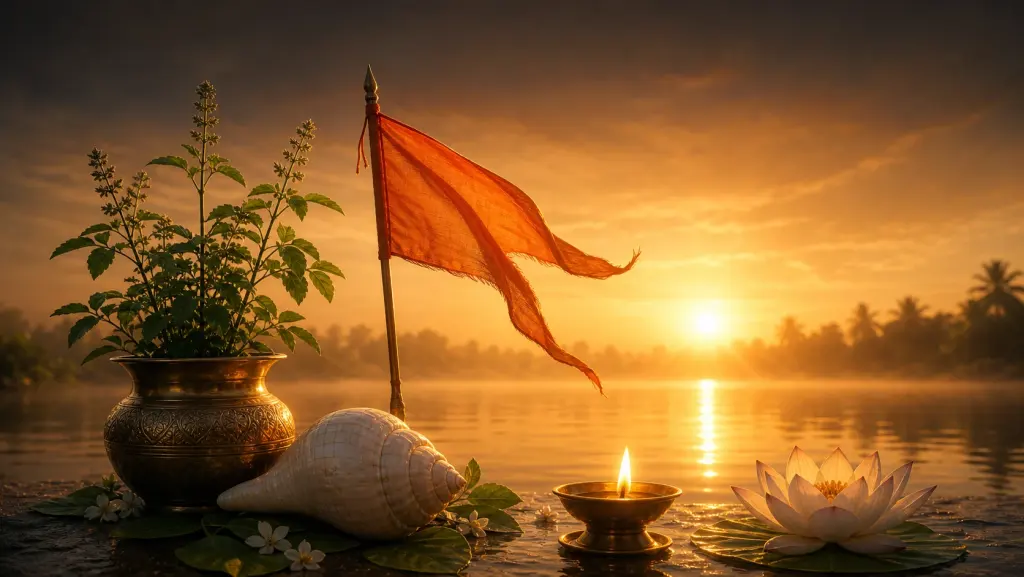
- Devotees worship Vishnu — often as Rama, given this day's story — with tulsi leaves, lamps and the day spent in remembrance, chanting or reading rather than feasting.
- Some begin the discipline from the evening before (Dashami) by eating an early, simple meal, and many keep a night vigil (jagran) with bhajan or recitation.
- The fast is broken the next morning at parana, within the prescribed window after sunrise on Dwadashi — not before it and not after Dwadashi ends. The first food is usually simple and sattvic.
- Because Vijaya Ekadashi is tied to overcoming obstacles, it is commonly taken up by those starting something difficult — an exam, a court matter, a venture — as a focused day of resolve.
How this date is determined
Observed on the Ekadashi tithi of Phalguna (Krishna paksha), reckoned by sunrise (udaya tithi).
Dates are computed to astronomical precision (NASA/JPL ephemeris), in line with traditional panchang.