Shat Tila Ekadashi
Lord Vishnu
When it falls
The date shifts because it tracks the moon, not the Gregorian calendar.
Calculated for India (IST) using precise Panchang astronomy. Dates can shift by a day at locations far to the east or west.
Significance & the six uses of til
Ekadashi — the eleventh day of each lunar fortnight — is kept across the year as a fasting day for Lord Vishnu, and there are two every lunar month, one in the waxing fortnight and one in the waning. Each has its own name and its own emphasis. Shat Tila Ekadashi is the one that falls in the waning fortnight (Krishna Paksha) of Magha, in the cold weeks of January or February. What sets it apart from the other Ekadashis is its link with sesame.
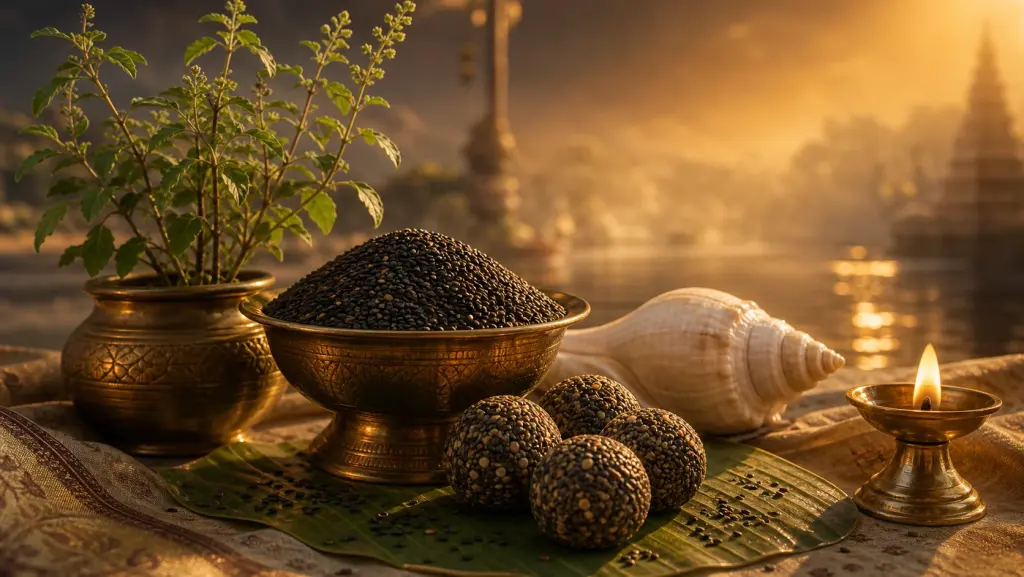
The name comes from "shat" (six) and "til" (sesame): the six uses of sesame seeds that give the day its character. Traditionally these are bathing with water mixed with til, applying a sesame paste, offering til in the fire or to Vishnu, eating food prepared with til, drinking til-water, and — the one most emphasised — giving sesame away in charity (daan). Sesame is a winter food and a traditional offering for the departed, so the day carries a quiet theme of warmth, simplicity, and giving rather than feasting.
Like all Ekadashis, the observance is built around restraint, not celebration. The point is a day set aside from ordinary eating and busyness, turned toward Vishnu through fasting, his name, and an act of charity. Because it is tied to the Magha Krishna Paksha Ekadashi tithi and not to a fixed calendar date, the Gregorian day shifts each year, usually landing in late January or early February.
Rituals & observance
The day combines a Vishnu fast with the six traditional uses of sesame (til). Practice varies by family and region, but the common elements are these:
- Keep an Ekadashi fast for the day. Many observers take only fruit, milk, and non-grain (phalahar) food; some keep a stricter fast without grains, beans, or — in the strictest form — without food entirely.
- Avoid rice, grains, and pulses, which are traditionally set aside on every Ekadashi.
- Worship Lord Vishnu — bathe and dress the image or picture, offer flowers, a lamp, and til, and chant his names or read the day's katha (story).
- Use sesame (til) through the day in its traditional ways: bathing with til-water, taking food made with til when breaking the partial fast, and including it in the offerings.
- Give sesame in charity (daan) — the act most associated with this Ekadashi — along with food or other items to those in need, ideally on the day itself.
- Break the fast the next morning at parana time, on Dwadashi (the twelfth tithi), within the prescribed window after sunrise and before the tithi ends — not at night.
Regional variations
How this date is determined
Observed on the Ekadashi tithi of Magha (Krishna paksha), reckoned by sunrise (udaya tithi).
Dates are computed to astronomical precision (NASA/JPL ephemeris), in line with traditional panchang.