Dev Diwali
Lord Shiva
When it falls
The date shifts because it tracks the moon, not the Gregorian calendar.
Calculated for India (IST) using precise Panchang astronomy. Dates can shift by a day at locations far to the east or west.
Significance & story
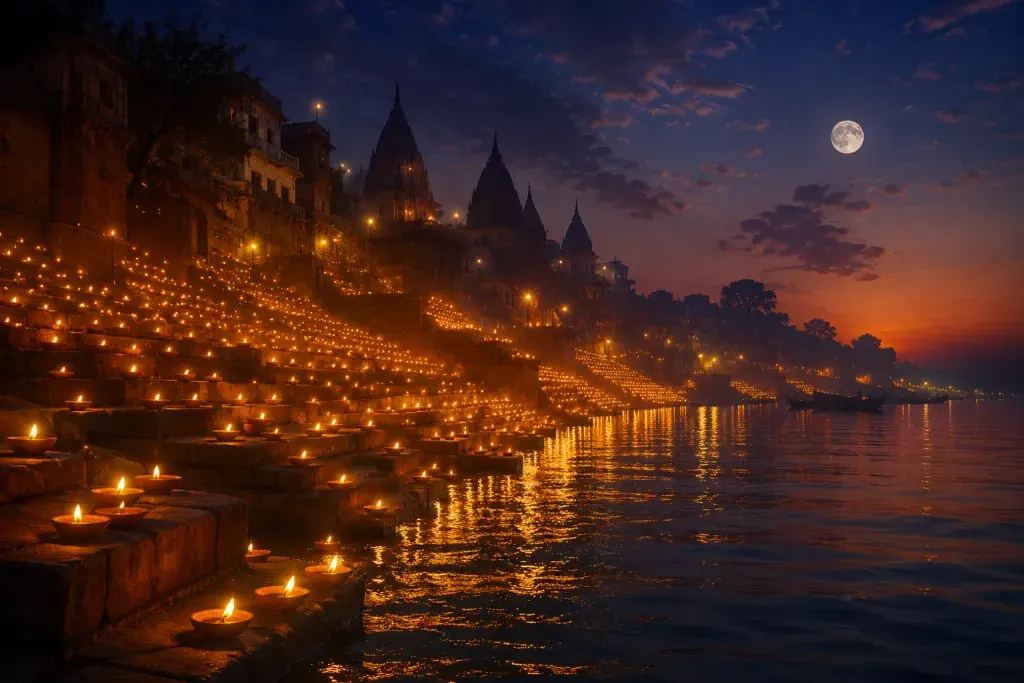
Dev Diwali means the "Diwali of the gods." Where the better-known Diwali is a festival of people and homes, this one belongs to the deities: tradition holds that on the Kartik full moon the gods descend to earth to bathe in the Ganga at Kashi (Varanasi), and the city lights lamps to welcome them. It falls on Kartik Purnima, the bright full moon fifteen days after Diwali, and closes the lamp-lit season that began with that festival.
The day is also called Tripurari Purnima, after the story that gives it its weight. The demon Tripurasura had won control of three fortified cities — collectively Tripura — and grown impossible to defeat. Shiva destroyed all three with a single arrow, and the gods lit lamps in relief and thanksgiving at his victory. This is why the day is dedicated to Lord Shiva, and why light, rather than feasting, is the central act: the lamps mark both the welcome of the gods and the celebration of a battle won.
The same Kartik full moon carries other observances layered onto it — it is kept as Guru Nanak's birth anniversary by Sikhs, and as a major bathing day on the Ganga for pilgrims. So the date is shared, but in the Dev Diwali sense the focus stays on Shiva, on the river, and on the act of offering light at dusk.
Rituals & observance
How Dev Diwali is kept:
- The defining sight is the lighting of lamps (deepdaan) along the river — earthen diyas placed in long rows down the ghats and steps at dusk, and small leaf-boats of light floated out onto the water.
- A holy dip in the Ganga (or another sacred river) at dawn on the Kartik full moon is considered especially meritorious; many fast or eat lightly through the day until the bathing and worship are done.
- In Varanasi the evening centres on a grand Ganga aarti performed in unison across the main ghats, with conch, bells, and rows of priests waving lamps to the river.
- Shiva is worshipped through the day, in keeping with the festival's link to his victory as Tripurari; temples and homes keep lamps burning into the night.
- Households and temples light lamps at their doorways and on rooftops, much as at Diwali, extending the season of light by a fortnight.
- Charity and offering — giving food, lamps, or alms — are traditional on this full moon, treated as a day when such acts carry added merit.
Regional variations
How this date is determined
Observed on the full-moon day (Purnima) of Kartik (Shukla paksha), reckoned by sunrise (udaya tithi).
Dates are computed to astronomical precision (NASA/JPL ephemeris), in line with traditional panchang.