Rash Purnima
Lord Krishna, Radha
When it falls
The date shifts because it tracks the moon, not the Gregorian calendar.
Calculated for India (IST) using precise Panchang astronomy. Dates can shift by a day at locations far to the east or west.
The story and meaning of Rash Purnima
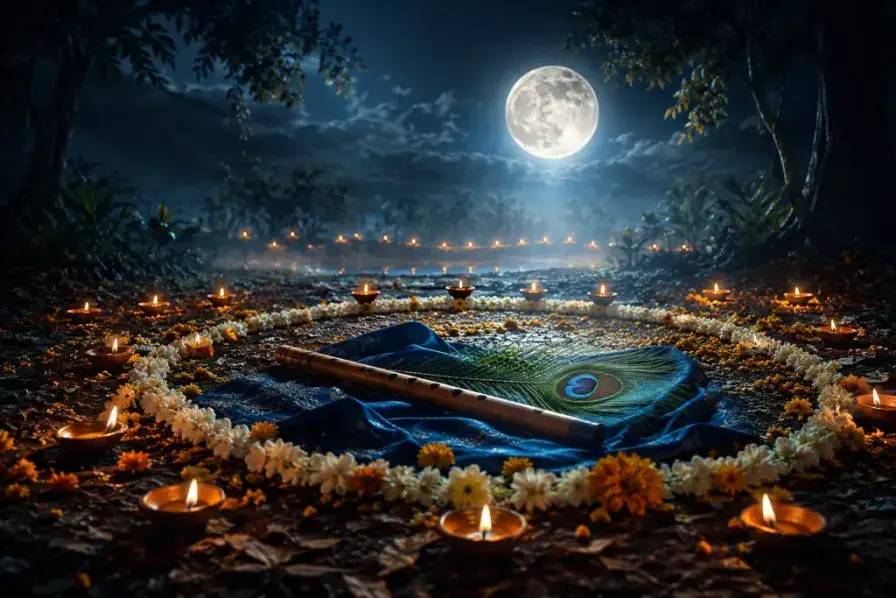
Rash Purnima takes its name from the Rasa Lila (raas) — the circle dance Krishna is said to have shared with Radha and the gopis on a full-moon night in Vrindavan. In the tradition, the dance is read not as romance for its own sake but as a picture of the soul's longing for the divine, with Radha standing for complete, undivided devotion. Celebrating it on the Kartik full moon links the festival to the brightest, calmest night of an already sacred month.
The festival falls on Kartik Shukla Purnima, the same full moon that elsewhere is kept as Kartik Purnima and Dev Diwali. Because the date tracks the moon and not the Western calendar, it shifts each year and usually lands in November. The full moon itself is central: the all-night worship, the lamps, and the swinging of the idols all belong to a night meant to be spent awake in remembrance.
While the underlying story is shared across the Krishna tradition, the public festival is strongest in two regions. In Bengal it is Rash Yatra, a temple and household observance of Radha-Krishna. In Manipur it is the occasion for the celebrated Manipuri Raas Leela, a refined classical dance-drama performed in temple precincts. The same full moon, then, carries quite different public forms depending on where it is kept.
Rituals & observance
Observance centres on Radha-Krishna worship and on staying awake through the full-moon night. Practices vary by household and region, but the common threads are these:
- Bathe and clean the home and shrine, then dress and decorate the Radha-Krishna idols in fresh clothes, ornaments, and flowers.
- Place the idols on a decorated swing or seat and offer worship (puja) through the evening, often with kirtan and readings from the Krishna story.
- Light lamps and keep a night vigil — the full moon of Kartik is traditionally a night spent awake in devotion rather than sleep.
- Offer bhog and prasad such as sweets, fruit, and seasonal dishes, later shared among family and visitors.
- In Manipur, attend or take part in the Raas Leela dance performed in temple courtyards, which is the heart of the local celebration.
- In Bengal, visit Radha-Krishna and ISKCON temples, which hold special Rash Yatra programmes and decorated displays.
Regional variations
How this date is determined
Observed on the full-moon day (Purnima) of Kartik (Shukla paksha), reckoned by sunrise (udaya tithi).
Dates are computed to astronomical precision (NASA/JPL ephemeris), in line with traditional panchang.