Buddha Purnima
Lord Buddha
When it falls
The date shifts because it tracks the moon, not the Gregorian calendar.
Calculated for India (IST) using precise Panchang astronomy. Dates can shift by a day at locations far to the east or west.
Why Buddha Purnima matters
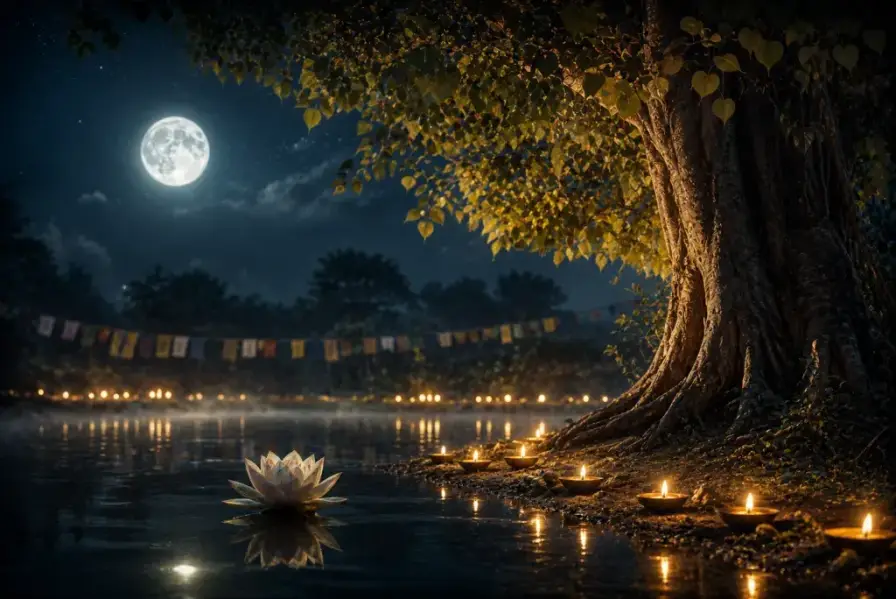
Buddha Purnima falls on the full moon (purnima) of Vaishakha, the lunar month that usually corresponds to April or May. The day commemorates Gautama Buddha, who was born a prince in the Shakya clan and gave up palace life to seek an end to human suffering. A widely held tradition holds that three central events of his life — his birth, his awakening (bodhi) under the Bodhi tree at Bodh Gaya, and his passing into final peace (mahaparinirvana) — all occurred on this same full-moon day, which is why it carries such weight.
For Buddhists across the world this is the highest holy day of the year, known internationally as Vesak. In India it is also observed by many Hindus, who regard the Buddha as one of the avatars of Vishnu, so the day sits comfortably within the shared festival calendar. The emphasis is less on celebration and more on reflection — on the Buddha's teaching that craving causes suffering, and that a disciplined, compassionate life leads beyond it.
Because it is a full-moon observance, Buddha Purnima belongs to the same family of purnima days as Guru Purnima and Sharad Purnima, each marking its own occasion under the bright fullness of the moon. It is a public holiday in India and several other countries with significant Buddhist populations.
Rituals & observance
Observance on 20 May 2027 is quiet and centred on remembrance, charity, and self-restraint rather than festivity. Common practices include:
- Visiting a vihara, monastery, or temple to offer flowers, incense, and lamps before an image of the Buddha, and to listen to readings from his teachings (the Dhamma).
- Lighting lamps or candles, which represent the light of wisdom dispelling ignorance — many homes and shrines are decorated with rows of small lamps for the evening.
- Keeping the day simple and meritorious: many observe a vegetarian diet, take the precepts, and avoid harming living beings; some take a vow of silence or spend time in meditation.
- Giving to those in need — food, clothing, or alms to monks and the poor — as the day is strongly associated with generosity (dana).
- Reciting and reflecting on the Buddha's life and the core teachings, sometimes through community chanting or processions to a Bodhi tree.
- Taking a ritual bath at dawn and offering water; in some regions a Bodhi tree is watered and circumambulated as a mark of respect to the place of enlightenment.
Regional variations
How this date is determined
Observed on the full-moon day (Purnima) of Vaishakha (Shukla paksha), reckoned by sunrise (udaya tithi).
Dates are computed to astronomical precision (NASA/JPL ephemeris), in line with traditional panchang.